One moment
Preparing the page.
Loading content…One moment
Preparing the page.
Loading content…Laser skin resurfacing rebuilds the quality of your skin's surface: texture, acne scarring, pigment and sun damage, pores and the redness that never quite settles. Ablative resurfacing runs as a course of about three sessions six to eight weeks apart, with several days of redness and peeling each time; the non-ablative and vascular settings leave the surface intact and need essentially no downtime. It is not a lifting treatment, and confusing the two is the commonest reason people are disappointed. It works by choosing a wavelength for a specific target in the skin, placing a controlled injury exactly there, and letting your own repair machinery lay down newer, better-organised tissue. Our Fotona is a LightWalker platform carrying two wavelengths, an Er:YAG at 2940 nm that works with micron precision at the surface, and an Nd:YAG at 1064 nm that reaches the vessels beneath it. The result people describe is skin that looks well rather than treated. It is a different job from lifting, and knowing which of the two you need is where we start.
You have been told your skin needs "resurfacing," and the word has never quite explained itself. It sounds like sanding a floor. What it actually describes is a controlled injury, delivered in light, at a depth measured in microns, that persuades your skin to rebuild its surface from underneath. The precision is the treatment. Everything else is consequence.
Laser skin resurfacing uses a specific wavelength of light to remove or heat a controlled fraction of the skin so that the tissue which replaces it is smoother, more even and better organised than the tissue it replaced. It is the treatment for the quality of the surface: texture, acne scarring, pigment, sun damage, pores and vascular redness. It is a different job from lifting, and confusing the two is the single most common reason people choose the wrong laser.
| Laser resurfacing | In brief |
|---|---|
| What it treats | The quality of the skin surface: texture, acne scarring, pigment and sun damage, pores, and vascular redness. |
| How it works | Light absorbed by a target in the skin, converted to heat, triggering a controlled wound-healing response that lays down new collagen. |
| The wavelengths | Er:YAG at 2940 nm sits on the water-absorption peak and works at the surface. Nd:YAG at 1064 nm passes deeper and is absorbed by haemoglobin and melanin. |
| The choice you are making | Ablative or non-ablative. This is a choice about downtime and depth, not about better or worse. |
| What it is not for | Laxity and descent, which are a question of support rather than surface, and belong to the lifting side of the laser or to surgery. |
| Where | Performed at the clinic in Bath, on a Fotona LightWalker platform. |
These two words get used as if they were the same promise. They are not, and the distinction is anatomical.
Lifting is about tone and support in the deeper tissue. You warm the dermis and the layers beneath it without breaking the surface, existing collagen contracts, new collagen forms over the following weeks, and the skin holds better than it did. That is the subject of a separate article on the non-surgical facelift and how the laser lifts, inside the mouth and out. It is the same machine, in a different mode, doing a different job.
Laser skin resurfacing is about the surface itself. It treats what the skin looks like close up: the roughness, the scar that catches the light, the brown patch that arrived after a summer, the pore you can see in the mirror, the thread vein at the side of the nose. You are not asking the face to sit differently. You are asking the top of it to be rebuilt.
The reason this matters practically is that people arrive asking for the wrong one. Someone whose real complaint is a jawline that has softened will not be satisfied by a resurfacing course, however well it goes, because their skin quality was never the problem. Someone whose complaint is fifteen years of acne scarring will not be satisfied by a tightening protocol, because tightening does not fill a scar. Sorting which of the two you actually want is most of the consultation, and it is done by looking at your skin, not by reading a menu.
Every resurfacing decision runs through this fork, and it is worth understanding properly because it is the one variable that determines what your week after treatment looks like.
An ablative laser removes tissue. The energy is absorbed so strongly and so shallowly that the water in the cells vaporises, taking a precisely controlled layer of the surface with it. Beneath that, a narrow zone of heat triggers repair. The skin then regenerates from the untreated tissue around and below, and what grows back is newer and better organised. This is the more powerful route, and it is the more demanding one: you get redness and peeling for several days while the surface reconstitutes.
A non-ablative laser leaves the surface intact. The energy passes through the epidermis and deposits heat in the dermis below, prompting the same repair cascade without breaking the skin. Less downtime, less drama, and a smaller effect per session, which is why non-ablative work is done as a course rather than an event.
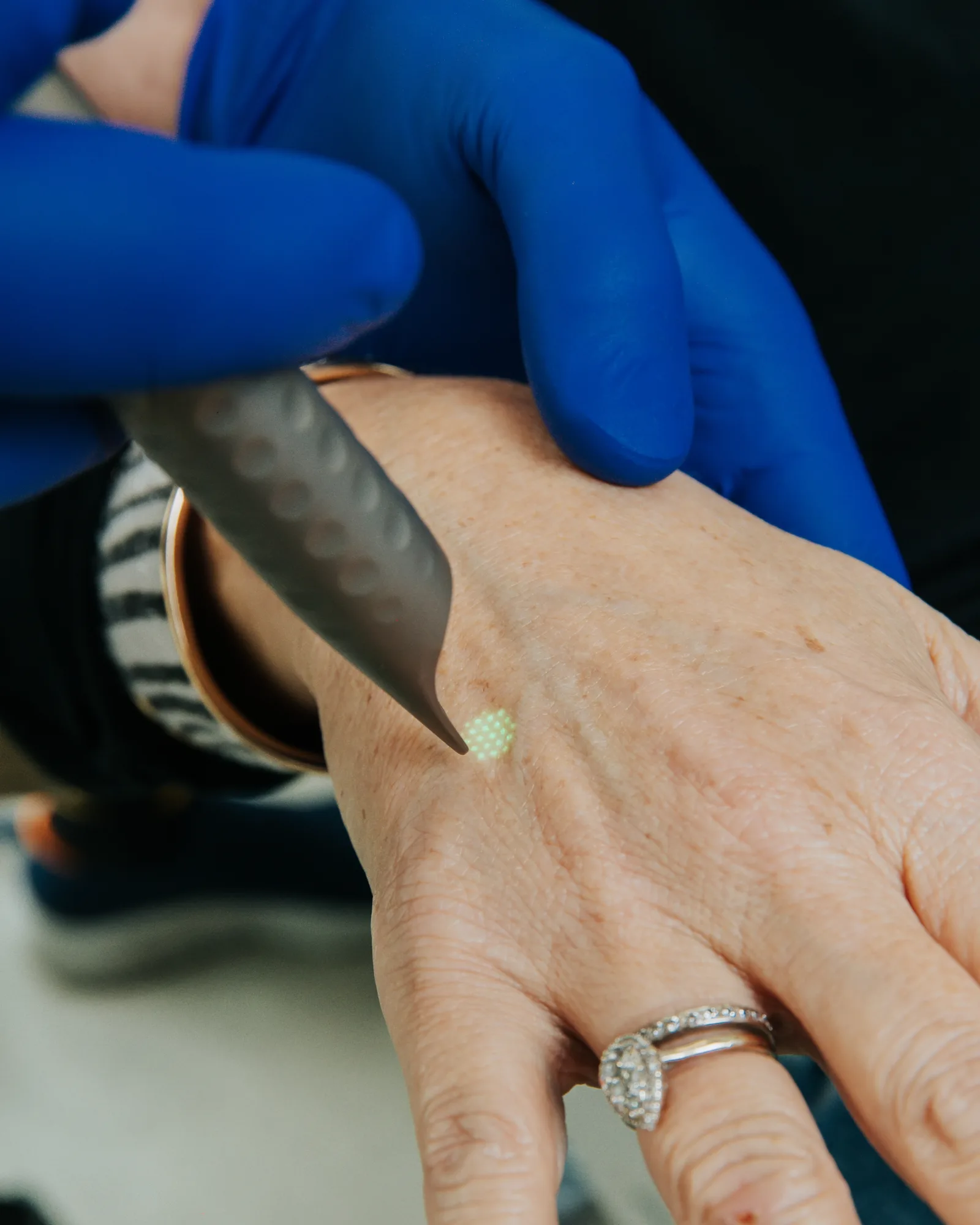
Fractional cuts across both. Instead of treating the whole surface, the beam is split into a grid of microscopic columns, so that treated zones sit surrounded by untreated skin. Those untreated islands are reservoirs of intact tissue that drive rapid healing across the whole field. Fractional delivery is what made meaningful resurfacing compatible with an ordinary life, and it can be done ablatively or non-ablatively.
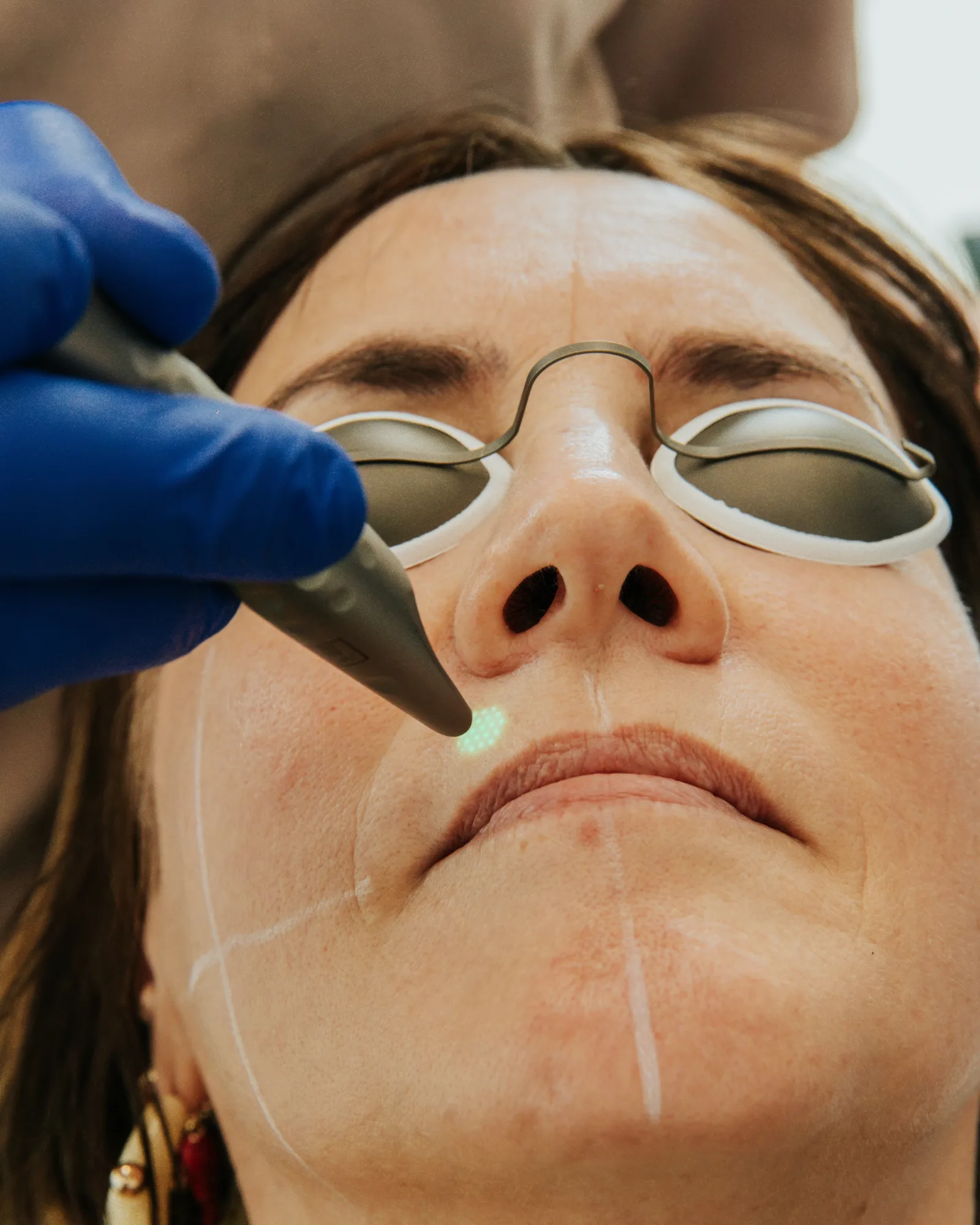
The honest framing is that this is a trade, not a hierarchy. Push deeper and you get more correction per session and more recovery. Stay superficial and you get less per session, no meaningful downtime, and you make it up in number. Low-energy fractional Er:YAG run over multiple sessions has been studied precisely as that bargain, and it delivered: of the twelve subjects who completed, all recorded improvement, half reported over fifty per cent improvement, and there was no downtime associated with the procedure (multiple-treatment low-energy study, sixteen enrolled and twelve completed, PMID 21401375). Twelve people is a small trial, so I treat it as a principle rather than a number to quote back to you. The principle matters though: the aggressive setting is a choice, not a requirement, and for a great many people the gentler route reaches the same place with their week left intact.
This is where laser stops being a brand and becomes physics. A laser does nothing on its own. It emits one wavelength of light, and what that light does depends entirely on what in your skin absorbs it. The absorbing target is called a chromophore, and the three that matter in skin are water, haemoglobin and melanin. Match a wavelength to a chromophore and you can deposit energy in one structure while leaving its neighbours untouched. That principle, selective photothermolysis, is the foundation the entire field rests on, and it was set out in 1983: brief pulses of selectively absorbed light damage the target structure alone, because the optical and thermal properties of the target supply the selectivity, so precise aiming is unnecessary (original description of selective photothermolysis, PMID 6836297).
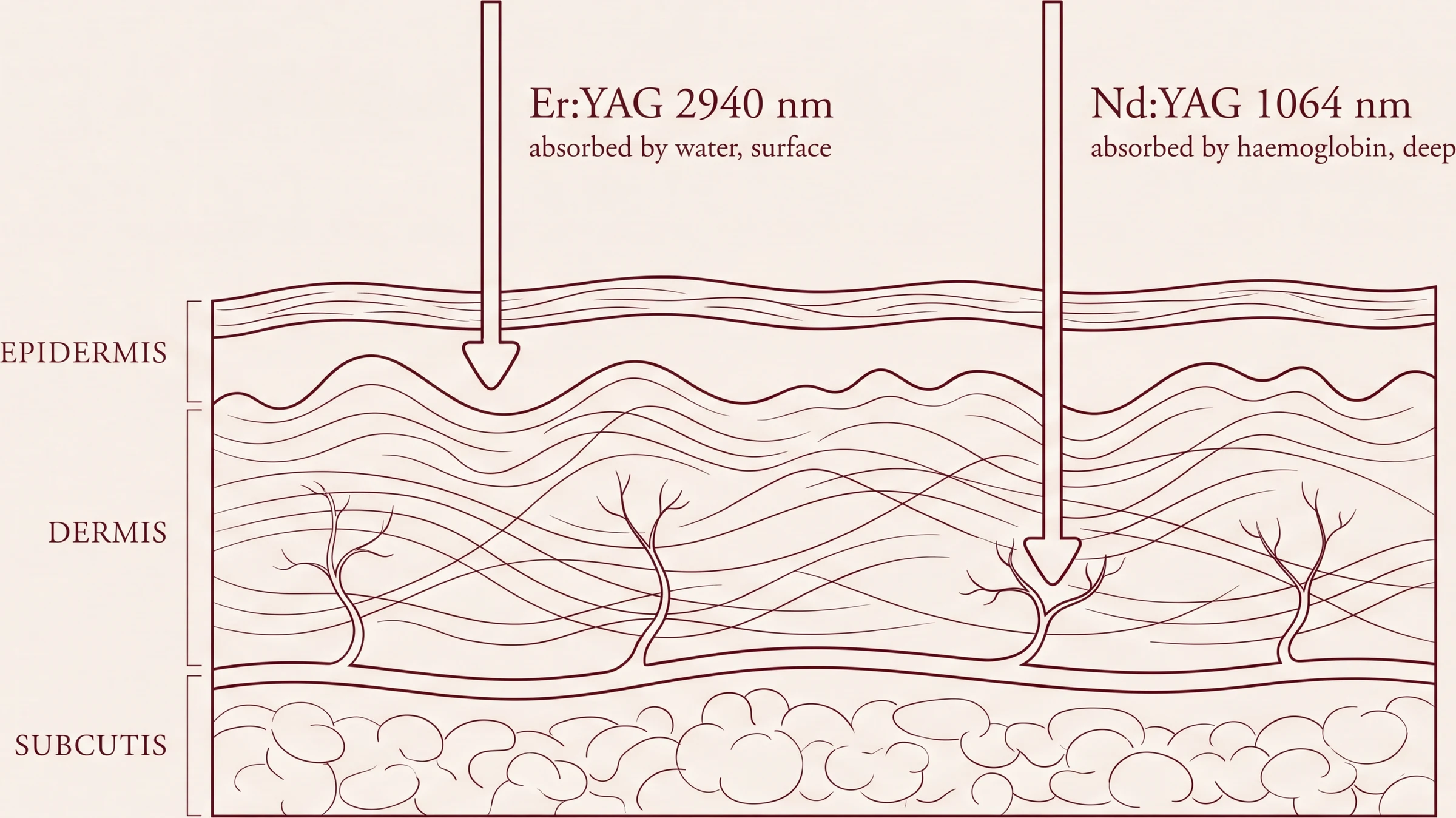
Er:YAG, 2940 nm. This wavelength sits essentially on the peak of water's absorption curve. Skin is mostly water, so the energy is consumed almost immediately on arrival. It does not travel. That gives Er:YAG something no other resurfacing wavelength has to the same degree: depth control measured in microns, with very little heat spilling into the tissue below. The clinical consequence is exactly what you would predict from the physics. Because of its minimal penetration, the Er:YAG produces less postoperative morbidity, and the literature names it the treatment of choice for fine lines and superficial scars, with the CO2 laser better suited to deeper rhytides and deeper scars (review of lasers for facial rejuvenation, PMID 12786881).
Nd:YAG, 1064 nm. A near-infrared wavelength, poorly absorbed by water, which is precisely why it goes deep. What it is absorbed by is haemoglobin and, to a lesser degree, melanin. That makes it the vascular tool: energy delivered into the blood inside a dilated vessel, heating the vessel wall until it collapses and is cleared, without ablating anything on the surface. Its long wavelength also means less scattering and less epidermal absorption, which is why it is the wavelength reached for in darker skin. In a split-body comparison in eleven patients of Fitzpatrick types IV to VI, post-inflammatory pigmentation followed the shorter-wavelength intense pulsed light and appeared on none of the sides treated with the 1064 nm Nd:YAG (split-body comparison, eleven patients, PMID 14660273). That was a hair-removal study rather than a resurfacing one, and eleven patients is a small number, so read it as the physics behaving as predicted rather than as a safety record.
Two wavelengths, two chromophores, two depths. The Fotona platform carries both, which is what allows a single session to work at the surface and in the deeper vasculature rather than forcing a choice between them. In perioral rejuvenation, a randomised comparison in thirty-six patients set the combined Nd:YAG and Er:YAG approach against a non-ablative 1550 nm erbium-glass laser. The erbium-glass was significantly better at reducing pore count. Improvement in corner-of-mouth lines reached significance only within the combined group, and on the lines above the lip the two were not significantly different, which the authors read as the combined approach suiting deeper wrinkles (randomised comparison, thirty-six patients, PMID 40537663). Worth being precise about that middle result: one group improving significantly while the other does not is not the same as the two being significantly different from each other. That is exactly the kind of detail worth knowing, because it is how a treatment gets matched properly: for pore refinement in isolation, the erbium-glass wavelength has the better published result. For depth, for vessels and for the perioral lines people most often come in about, the dual-wavelength approach is the stronger tool. Knowing which of those you actually want is the difference between a good result and an expensive approximation.
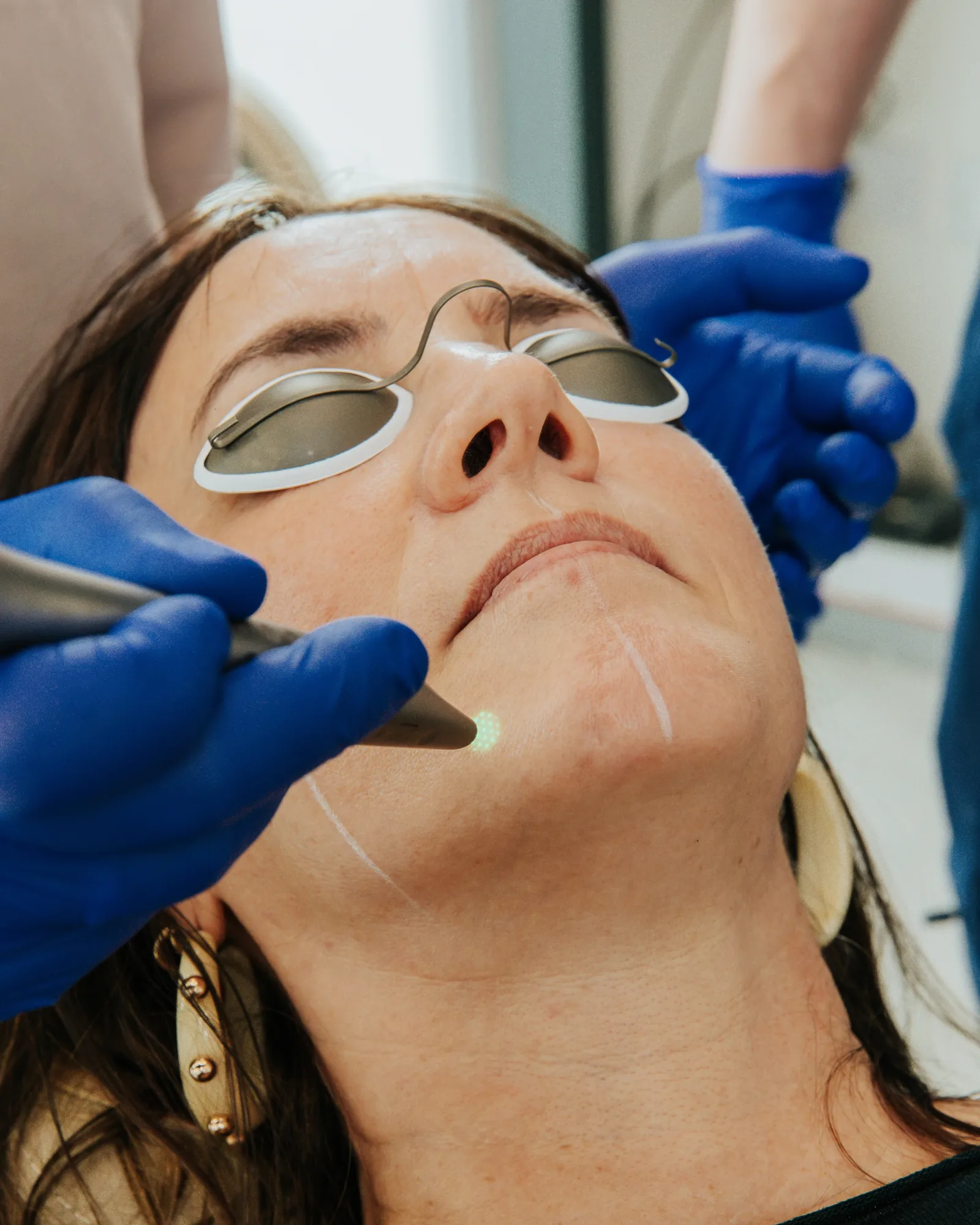
Here is the state of the science, with its edges left on.
The strongest recent synthesis is a 2025 meta-analysis of randomised and comparative trials, 497 patients across six studies, comparing lasers against other rejuvenation modalities. The Er:YAG laser produced the highest proportion of excellent responses of any modality examined, and the authors concluded that Er:YAG combined with radiofrequency surpasses other methods for restoring skin quality. The same analysis found pooled results across all modalities of eighteen per cent excellent, thirty-one per cent good and forty per cent fair (meta-analysis, PMID 40906045). Both halves of that are worth reading. The Er:YAG leads its field, and the spread across all modalities is wide. That spread is not a reason for pessimism; it is a reason for precision. Pooled figures average across every skin, every setting and every indication that was studied, which is precisely what a consultation exists to stop happening to you. The excellent results are real, and they belong to the people whose treatment was matched to what their skin actually needed.
On wrinkles specifically, ablative fractional Er:YAG and ablative fractional CO2 were compared head to head in forty patients, in a randomised, double-blind, split-face trial across three monthly sessions. Both significantly reduced facial wrinkles, with no appreciable difference between the two lasers (split-face RCT, PMID 27885522). The CO2 is often marketed as the serious option. On wrinkles, in a controlled comparison, it was not better.
On firmness and skin quality more broadly, expert consensus places fractional lasers among the preferred treatments, notes that the magnitude of improvement with ablative lasers appears greatest, and adds the caveat that matters most for safety: non-ablative lasers, and those targeting water rather than melanin, are safest for skin of colour (consensus algorithm, PMID 40847902).
On acne scarring, the honesty has to be sharper. A systematic review of laser resurfacing for facial acne scars found no controlled trials at all, only case series, all of poor quality, with improvement in individual patients ranging from twenty-five to ninety per cent (systematic review, PMID 10735944). The treatment genuinely works, and that range is wide for a reason worth understanding: scars are not one thing. Rolling, boxcar and ice-pick scarring respond quite differently, so a number averaged across all three tells you very little about your own face. Which is why assessment comes before energy, and why acne scarring has an article of its own.
On pigment, laser and laser-based combinations significantly reduce melasma severity, including fractional ablative Er:YAG, though the same review records post-inflammatory hyperpigmentation and hypopigmentation as real risks in darker skin (meta-analysis, PMID 35122202). Interestingly, in a direct comparison in thirty-four patients with photoaged Asian skin, ablative fractional Er:YAG beat non-ablative erbium-glass on pigmentation and uneven tone, while the non-ablative laser beat it on wrinkles and on the overall assessment (double-blind randomised comparison, thirty-four patients, PMID 26417998). The authors' own conclusion is that the two are complementary, not rivals. Which kind of pigment you have decides all of this, and one kind can be made worse by laser, which is set out in the article on pigmentation, sun spots and melasma.
On vascular redness, the Nd:YAG has a genuine record. Against pulsed dye laser in erythematotelangiectatic rosacea it achieved excellent response in 73 per cent of patients versus 53 per cent, with a significantly greater fall in substance P, the neuropeptide implicated in rosacea's inflammation (split-face comparison, fifteen patients, PMID 23992160). In fifteen patients that is eleven faces against eight, and the substance P difference is the part that was tested statistically. Both point the same way, which is why the Nd:YAG is what I reach for on vascular redness. The British Journal of Dermatology's GRADE-assessed review is more measured: low to moderate certainty evidence that Nd:YAG, pulsed dye laser and intense pulsed light reduce erythema and especially telangiectasia (systematic review, PMID 30585305). Visible vessels respond better than diffuse background redness. The full picture, feature by feature, is in the article on rosacea, thread veins and facial redness. That is the pattern in the data and the pattern in the room.
Every laser question reduces to one question: what in the skin is absorbing this photon, and how deep is it. Answer that and the wavelength chooses itself. Get it wrong and you have bought an expensive way to burn someone.
Dr Dana BeikiThe platform is not the plan. What follows is how the concerns actually sort.
| Your concern | The tool | Wavelength and mode | Downtime |
|---|---|---|---|
| Texture, fine lines, sun damage, established scarring | Fotona skin resurfacing | Ablative fractional Er:YAG | Several days of redness and peeling |
| Active acne with scarring | Acne and scar revision | Nd:YAG for the glands and bacteria, then Er:YAG at the surface | Minimal |
| Rosacea, flushing, visible vessels | Rosacea and vascular | Nd:YAG, targeting haemoglobin | Minimal |
| Perioral lines and lip quality | LipLase | Dual-wavelength, intraoral and external | Minimal |
| Texture with no appetite for downtime | Microneedling | Mechanical, not light | One to two days |
| Dull, crepey, dehydrated skin | Skin boosters | Injectable, not light | Minimal |
| Lost support and firmness in the lower face | Profhilo Structura | Injectable, not light | Minimal |
| Laxity and descent | Laser lifting or surgery | Non-ablative Er:YAG, or an operation | Varies |
Acne scarring is the deepest of these subjects, and which treatment suits you depends on the shape of your scars rather than their severity. That is set out in full in the article on laser treatment for acne scars.
The two acne routes deserve a word, because they are easy to confuse. Resurfacing is the ablative option for established atrophic scarring in skin where the acne itself has settled, and it asks for several days of recovery. Acne and scar revision is the dual-wavelength protocol for skin where acne is still active: the Nd:YAG reaches the sebaceous glands and the bacteria, the Er:YAG works at the surface, and there is essentially no downtime. Treating scars while the acne is still producing new ones is work you will have to do twice.
Resurfacing suits skin whose problem is its surface. Roughness, dullness, sun damage, an uneven tone, atrophic acne scarring, visible pores, thread veins, the fine lines around the mouth and eyes that are there whether or not you are moving. If you have looked at your skin close to a mirror and thought the texture is the thing, this is the right chapter.
One caution about the under-eye. Patients often arrive asking for resurfacing there because the area looks dark, and pigment is only one of the four things that produce a dark circle. If the shadow is structural or vascular rather than pigmented, a laser aimed at melanin will not touch it. That sorting is worth doing first, and it is set out in the article on what actually causes dark circles.
It suits someone willing to be governed by the sun. This is not a soft recommendation. Ultraviolet exposure before and after ablative treatment is the main driver of post-inflammatory hyperpigmentation, and expert consensus is built around it: strict sunscreen beginning no later than four weeks before treatment, and a pre-treatment topical regimen from about four weeks before, stopping shortly beforehand (expert consensus on fractional ablative CO2 laser, twenty-one panelists, PMID 39434507). That panel did not agree on how long to avoid the sun beforehand, splitting between two to four weeks and one to two, which is worth knowing because it tells you the discipline matters more than the exact number. A resurfacing course begun in June, with a holiday booked, is a course begun badly.
Skin of colour needs a specific answer, not a nervous one. The risk in richly pigmented skin is real: melanin absorbs light, and heat delivered to the epidermis in a skin with abundant melanin can produce post-inflammatory hyperpigmentation. But the response to that is technical, not exclusionary. Non-ablative and epidermis-sparing approaches, and wavelengths that target water rather than melanin, are the safer route (consensus algorithm, PMID 40847902), and a randomised split-face trial found non-ablative fractional resurfacing safe and effective for acne scarring in Fitzpatrick phototypes IV to VI (randomised split-face trial, seven patients, PMID 26945321). That trial had seven patients, and its most useful detail is the density: post-inflammatory hyperpigmentation was common, in five of the seven at the higher treatment density and three of seven at the lower, and self-limited in every case. Lower density, wider spacing and longer intervals is the answer that follows from it, and it is how I set the machine for pigmented skin. The Nd:YAG's long wavelength is part of the same answer. Lower energy, wider spacing, longer intervals, and a patch test first. What is not acceptable is running the same settings on every skin and calling the result bad luck.
It does not suit an active infection or inflammatory flare in the treatment area, isoretinoin use in the recent past, a history of keloid scarring, or pregnancy. And it does not suit the person whose real concern is laxity. If your face has descended rather than deteriorated, resurfacing will improve your skin and disappoint you, because it was never the treatment for what you came in about. That belongs to the lifting side, or to surgery, and I will tell you so plainly.
This is the part most articles skip, and it is the part that explains why so many different treatments produce a similar-sounding result.
Almost everything in this field converges on one endpoint: activate the fibroblast, and get it to lay down new collagen in a better-organised arrangement than the tissue it replaced. The wound-healing cascade is the same regardless of what started it, and it runs through four programmed phases: haemostasis, inflammation, proliferation, and remodelling (review of wound healing, PMID 20139336). Inflammation brings the cytokines and the new vessels, proliferation brings the fibroblasts that synthesise collagen and elastin, and remodelling runs for months as the new matrix is reorganised. What separates the treatments is the route in.
Laser gets there through selectively absorbed light converted to heat. The distinguishing feature is control: you choose the wavelength, so you choose the target, and you choose the fluence, so you choose the depth. Nothing else in the field can place its injury with that specificity. It is described as highly targeted, able to affect the dermis precisely, effective for depressed scarring, with a short recovery period (acne-scar systematic review, PMID 41081097).
Microneedling gets there mechanically. Needles create micro-channels, the same wound-healing response follows, and expression of type I collagen and the associated growth factors rises. Its advantages are the mirror image of the laser's: minimal damage, short downtime, and a lower risk of hyperpigmentation and scarring than lasers, which makes it a better first choice for thin, sensitive or richly pigmented skin (review, PMID 39086171). Its limitation is that it is less effective for severe or fibrotic scars. It is the gentler route to the same fibroblast, and it gets less far.
PRP is not an injury at all. It is a supply of your own concentrated platelet growth factors, added to a wound someone else created. That is why it appears in the literature as a partner rather than a competitor: added to ablative laser it improves acne scarring, satisfaction and post-procedural symptoms, and topical application after fractional laser can be as effective as injection, with less pain (review, PMID 39086171). It amplifies healing. It does not initiate it. The comparative literature places laser combined with PRP among the best-performing options for acne scarring, at the cost of being more painful than the gentler routes (systematic review, PMID 41081097).
Biostimulators take the slowest and most indirect route. Rather than wounding, they place a material in the dermis that fibroblasts respond to over months. Calcium hydroxylapatite stimulates fibroblasts in a contact-dependent way; poly-L-lactic acid works gradually as it is broken down. The endpoint is the same new collagen, arriving over six to twelve months rather than six to twelve weeks. They build substance. They do not resurface, because they never touch the surface.
Chemical peels get there chemically, removing the stratum corneum and, at greater depths, stimulating dermal fibroblasts to proliferate and produce new collagen. Against laser they are cheaper and broadly applicable, and appropriate for less severe presentations or for patients wanting less pain and lower complication risk (systematic review, PMID 41081097). What a peel cannot do is choose its depth with any precision. Acid diffuses. Light does not.
So the summary is this. Same destination, different vehicles. The laser buys the most precise placement of injury available anywhere in the field: you choose the wavelength, so you choose the target, and you choose the fluence, so you choose the depth. Nothing else here can be aimed that exactly. The gentler routes ask less and deliver less per session, which for some skins is the right trade. The whole of the clinical skill is knowing which set of terms your particular skin should take, and that judgement is the thing you are actually buying.
If you are unsure whether your concern is texture, pigment, vessels or laxity, that is the thing to settle before any energy goes near your face, and the first appointment is where it gets settled. A consultation at the clinic in Bath is free and commits you to nothing. We look at your skin properly, establish whether what is bothering you is texture, pigment, vessels or laxity, and I tell you plainly which of those a laser will move and which it will not. If we go ahead, the settings are chosen for your skin rather than run from a preset, you are told what the healing will look like before it happens rather than after, and the aftercare is specific to what we did.
Expect laser skin resurfacing to change the character of the surface. Texture softens, tone evens, the pores and fine lines that catch the light stop announcing themselves, and skin that had begun to look weathered starts reading as skin again. Most people describe it as looking well rather than looking treated, which is the point.
Expect it to keep improving after you stop. The remodelling that produces the result runs for months after the redness has gone, so the face in the mirror at three months is not the finished one.
Three things to hold in view. Deep scarring that is fibrotic and tethered may need releasing before resurfacing is worth doing. Ultraviolet exposure will undo pigment work faster than any laser rebuilds it, so the sun discipline is part of the treatment rather than advice attached to it. And laxity is a different problem in a different layer, which is why we sort that at the start rather than discovering it at the end.
What it will do is unusual, and worth stating precisely. It lets us select a wavelength for a target, choose a depth in microns, place a controlled injury exactly there, and let your own repair machinery rebuild the surface better than it was. Er:YAG at the water peak for the surface, Nd:YAG at 1064 for the vessel beneath it. Not a stronger treatment than the alternatives. A more precisely aimed one.
However you begin, it starts with a conversation.
Book a consultation with Dr Beiki, or start free with an online assessment in your own time.
Rated 5.0 on Google · 30 reviews
Goodlight Wellness Center · Bath