One moment
Preparing the page.
Loading content…One moment
Preparing the page.
Loading content…Acne scar laser treatment works better than most people have been led to believe, once it is matched to the shape of the scar rather than applied uniformly across the face. There are three atrophic shapes, rolling, boxcar and ice pick, and they do not respond equally. Rolling scars are tethered from beneath and lift once that tether is released. Boxcar scars respond well to fractional resurfacing. Ice pick scars need a targeted approach rather than a broad one. And a good deal of what people bring in as scarring is flat red or brown marking, which will fade. Read the geometry first, combine the techniques it calls for, and the change is real: a surface that no longer catches the light, and a face you stop arranging your day around.

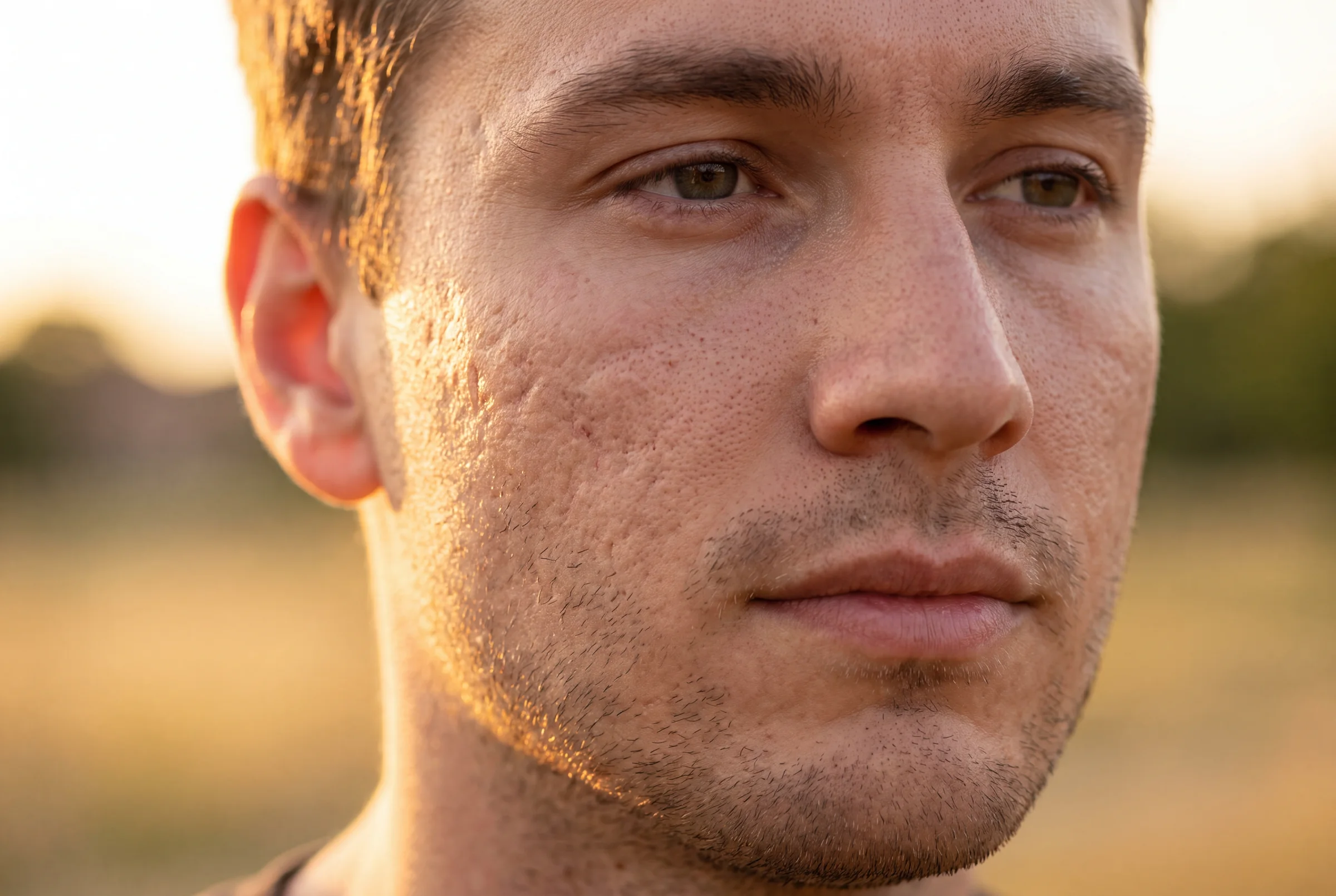
There is a particular light that finds them. Not the bathroom mirror straight on, where the skin looks passable, but the low sun through a car window, or the overhead light in a lift, raking across the cheek from the side. That is when the surface stops reading as skin and starts reading as terrain. People who have acne scarring know exactly which light that is, and often arrange their day around it.
Here is what that light is doing: it is not showing you colour, it is showing you depth. And depth is the whole of this subject. Because the single question that determines what your scarring will respond to is not how bad it looks, or how long you have had it. It is what shape it is.
Almost everyone arrives asking whether laser works for acne scars. That is the wrong first question, and answering it honestly requires taking two steps back.
A large share of what people call acne scars are not scars. They are marks, and the distinction is not pedantry. It changes the treatment, the timescale and the cost.
When a spot heals it commonly leaves a flat discolouration. If it is pink or red, that is post-inflammatory erythema: dilated vessels left behind by the inflammation. If it is brown or grey-brown, that is post-inflammatory hyperpigmentation: melanin dropped into the tissue by an inflamed follicle. Acne-induced hyperpigmentation can accompany acne in every skin phototype, and it is common enough in richly pigmented skin that treating it is considered part of treating the acne itself (phase IV trial, PMID 38685118).
Both of these are flat. Run a fingertip across them, or look at them in that raking light, and the surface does not move. They are a colour problem sitting in smooth skin, and they fade, over months, sometimes a year or more, faster with sun protection and the right topical work.
This is also where topical treatment genuinely earns its place, and it is worth being precise about what it earns. Retinoids are the best-evidenced topical route for post-inflammatory hyperpigmentation: in a controlled trial, a topical retinoid alongside a proper skincare and sun-protection routine significantly improved acne-induced hyperpigmentation against vehicle (phase IV RCT, PMID 38685118). That is a real result, and it is a result about colour. No topical rebuilds lost dermal collagen, so no cream, serum or acid will fill an indentation. Retinoids for the marks, procedures for the architecture, and anything sold as doing both is overreaching on one of them.
A true scar is an architectural problem. The inflammation reached the dermis, damaged the follicle and the tissue around it, and the repair either laid down too little collagen or laid it down disorganised. What you are left with is a change in the shape of the skin, not the colour of it. It casts a shadow. It does not fade, because there is nothing to fade.
So the first thing worth doing is the fingertip and the raking light. Flat and coloured will improve on its own with time and sun discipline, and it deserves patience and the right topical care rather than a laser course. Indented and shadow-casting is structural, permanent without intervention, and the subject of everything below.
Scarring is common enough to take seriously: up to 47 per cent of people with acne develop some degree of it (network meta-analysis, PMID 41081097). If you want the clinic's overview of the condition rather than the science behind treating it, that sits on the acne scarring page.
Atrophic scars, the indented kind, are the great majority of acne scarring, and they come in three recognised forms. The word simply means the tissue is depressed rather than raised: collagen was lost or laid down poorly. The opposite kind, hypertrophic and keloid scars, sit proud of the skin and are treated completely differently; they are uncommon on the face and are not the subject here.
The three atrophic forms look much alike in the mirror and behave completely differently under treatment, which is the single most useful thing to understand before choosing anything.
| Scar type | What it looks like | Typical size | Why it behaves as it does |
|---|---|---|---|
| Ice pick | Narrow, deep, V-shaped, like a puncture | Under 2 mm wide, disproportionately deep | Extends into deep dermis or below. Very little surface area, very great depth |
| Boxcar | Round or oval crater with sharp vertical walls | 1.5 to 4 mm, well-defined borders, fairly uniform depth | Defined edges and a flat floor, like a small excavation |
| Rolling | Broad, shallow, undulating, a wave in the skin | 4 to 5 mm, sloping edges | The surface is tethered from beneath by fibrous bands pulling it down |
Those descriptions come from the standard classification used across the literature (review of atrophic scar classification, PMID 41927510). Most people have a mixture, in different proportions on different parts of the face, which is why a single treatment applied uniformly across a cheek gives an uneven result.
Now the part that is rarely said out loud in clinic. The three types do not respond equally, and the gap is large. In a randomised trial combining a collagen-stimulating injectable with fractional laser, improvement separated by subtype in sixty patients: rolling scars improved most, then boxcar, then ice pick (randomised trial, sixty patients, PMID 40476635). Be precise about what that trial tested. It compared the combination against laser alone and found that difference significant. The ranking between scar types it reports as a direction, not as a tested difference between subtypes. An independent review of platelet-concentrate work reports the same ranking: rolling responded best, followed by boxcar, then ice pick (review, PMID 39086171).
That ordering is the most useful thing on this page. If your scarring is predominantly rolling, which is common, the outlook is genuinely good. If it is predominantly ice pick, the route is a targeted one rather than a broad one, and knowing that before we begin is exactly what makes the result satisfying rather than disappointing.
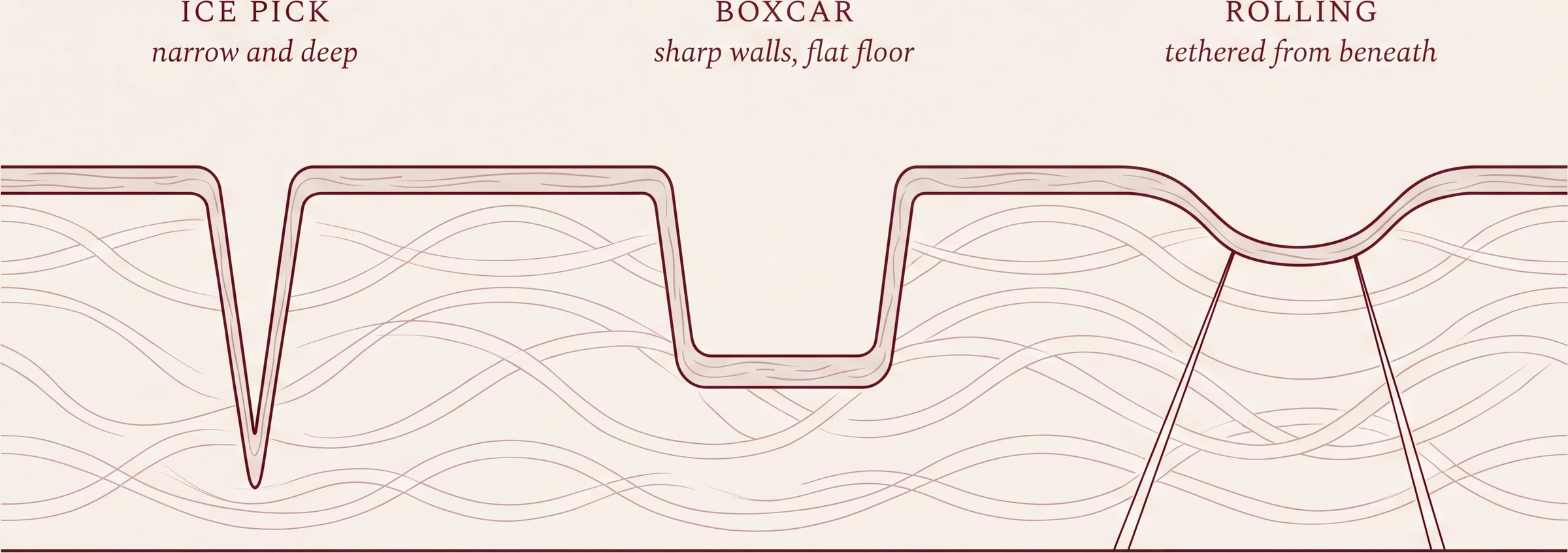
A rolling scar is not a hole. The surface is intact and roughly normal thickness; it is being pulled down from underneath by fibrous strands anchoring it to deeper tissue. That is why the skin undulates rather than pitting.
Resurfacing the top of a tethered scar treats the wrong layer. You can smooth the surface texture and the depression will still be there, because the thing causing it sits below the depth any resurfacing laser is working at.
The technique that addresses it is subcision: a fine needle is passed under the scar to cut the tethering bands, releasing the surface. The controlled bleed that follows organises into new tissue and lifts the depression further (technique review, PMID 41927510). It is a small, unglamorous procedure and it is frequently the difference between a good result and a disappointing one.
The combination is what the evidence supports. In a study of 413 patients, reported inside a 2026 systematic review rather than carried out by it, fractional CO2 laser combined with subcision achieved an overall efficacy rate of 92.09 per cent against 77.78 per cent for the laser alone (study reported in the systematic review, PMID 41927510). Release the tether, then resurface what is left. In the other order, or without the release at all, you are polishing a surface that is still being pulled.
Ice pick scars are the hardest thing in this field, and the reason is geometry. The scar is a narrow shaft running deep into the dermis. To resurface it away you would have to remove tissue down to its base across the whole surrounding surface, which would do far more damage than the scar does.
So they respond least to resurfacing, and the data above shows it. What works better is going after them individually rather than treating the field: a focused, high-precision approach that treats the shaft itself. Where an ablative laser is used on them, it reaches further into the dermis than a gentler energy device does, which is what the shape demands. Across the studies in the same systematic review, fractional CO2 laser and microneedling radiofrequency came out closely matched on overall efficacy (systematic review, PMID 41927510). So the case for choosing the ablative laser on ice pick scars is depth rather than a wider efficacy gap, and depth is precisely what this shape asks for.
Note the two facts sitting side by side, because they are easy to confuse. Ice pick scars respond worst overall. But if you are treating them, the ablative laser is the stronger tool for them than a gentler device. Both are true at once, and holding both is what lets us choose the technique for the outcome rather than for the machine.
The mechanism is the one described in full in the resurfacing hub: light absorbed by a chromophore, converted to heat, producing a controlled injury that runs the wound-healing cascade and lays down new, better-organised collagen. For scarring, the aim is to remodel a disorganised collagen architecture into something closer to normal lattice.
Two wavelengths do two jobs here, and our Fotona LightWalker carries both.
Er:YAG at 2940 nm sits on the water-absorption peak, so it ablates at the surface with depth control measured in microns and very little heat spilling sideways. The literature names it the treatment of choice for superficial scars, with CO2 preferred for the deeper ones (review, PMID 12786881). Ablative fractional lasers, Er:YAG and CO2, are the most-used treatments for atrophic acne scarring, with most ablative studies reporting improvements in the region of 26 to 75 per cent (network meta-analysis, PMID 41081097).
Nd:YAG at 1064 nm goes deep and is absorbed by haemoglobin. In scarring work it does two things: it reaches the sebaceous glands and the bacterial population driving active acne, and it targets the residual redness left behind by inflammation.
That second wavelength is what makes it possible to treat someone whose acne has not fully settled. A 2022 international consensus on energy-based devices for acne scars addressed exactly this, and a panel of twenty-four dermatologists and plastic surgeons across twelve countries was unanimous that energy-based devices have a role in managing acne scars, and considers them a first-line treatment for a variety of scar types. Their use in patients whose acne is still active was one of the questions the panel set out to address directly rather than avoid (international consensus, twenty-four specialists, PMID 34719045).
A scar is a shape, not a stain. Once you accept that, the whole conversation changes: you stop asking what will fade it and start asking what will change its architecture, and those are completely different tools.
Dr Dana BeikiEverything above explains what we do. This explains why we do it that way, because the method comes directly out of what the literature does and does not establish.
The Cochrane review of interventions for acne scars is blunt: there is a lack of high-quality evidence about the effects of the different interventions, owing to poor methodology, underpowered studies, no standardised way of assessing improvement, and differing baselines. Its one moderate-quality finding was that injectable filler might be effective for atrophic scars, with no study following patients beyond 48 weeks (Cochrane review, PMID 27038134). And I should put the sentence from that same review that cuts hardest against the consensus quoted above: its authors conclude that their results do not support the first-line use of any intervention for acne scars. Both statements are true at once. The consensus is the considered judgement of twenty-four specialists about what to do in clinic; the Cochrane finding is a verdict on the quality of the trials, not on whether the treatments work. That disagreement is exactly why I stage treatment and reassess rather than sell you a fixed course up front.
The laser-specific picture is similar. A systematic review of laser resurfacing for acne scarring found no controlled trials at all, only case series of poor quality, with improvement in individual patients ranging from 25 to 90 per cent (systematic review, PMID 10735944). Microneedling has the same problem from the other direction: every one of 33 studies reviewed showed improvement, but the evidence was inconsistent when compared against fractional laser (systematic review, PMID 31356435).
Where the evidence is better is on combinations. Adding platelet-rich plasma to microneedling or subcision produced a statistically significant reduction in scar severity across 241 participants (meta-analysis, PMID 32061047), and the network meta-analysis places laser combined with PRP or with filler among the best-performing options, at the cost of being more painful than the gentler routes (network meta-analysis, PMID 41081097).
Read together, those findings point somewhere specific. Single treatments applied uniformly produce inconsistent results. Combinations, matched to the scar, consistently outperform them. That is the most reliable signal in the whole literature, and it is precisely the approach this clinic is built around: release what is tethered, resurface what is walled, target what is narrow, and support the healing between stages.
It is also why I plan in stages and reassess as your skin responds, rather than selling a fixed package decided before I have seen how you heal. Staging is not caution. It is how you get the compounding result, because each stage is chosen with the evidence of the last one in front of us.
| Your scarring | The lead treatment | Why |
|---|---|---|
| Flat red or brown marks, smooth to the touch | Time, sun protection, topical work | Not a scar. It fades. Vascular laser only if redness persists |
| Rolling, broad and undulating | Subcision first, then resurfacing | The tether below must be released before the surface is worth treating |
| Boxcar, sharp-walled craters | Ablative fractional resurfacing | Responds well; the walls and floor are within reach of controlled ablation |
| Ice pick, narrow and deep | Focused, scar-by-scar treatment | Treated individually rather than across the field, because the shape is narrow and deep |
| Mixed, with acne still active | Acne and scar revision | Dual-wavelength: the Nd:YAG treats the acne while surface work begins |
| Mixed, acne fully settled | Ablative resurfacing | The more intensive correction, in exchange for several days of recovery |
| Any of the above, richly pigmented skin | Non-ablative or epidermis-sparing settings | Lower pigmentation risk, more sessions, slower and safer |
| Wanting gentler, less downtime | Microneedling, often with PRP | Less per session, lower risk, particularly reasonable for thin or pigmented skin |
This needs a specific answer rather than a nervous one, because acne scarring is if anything more consequential in richly pigmented skin, where post-inflammatory hyperpigmentation compounds the scarring itself.
Ablative resurfacing carries a real risk of post-inflammatory hyperpigmentation, and pigment change after laser resurfacing for acne scarring has historically been common, in up to 44 per cent of patients in the older literature, though it typically lasted only weeks (systematic review, PMID 10735944). Fractional delivery may reduce this. In one 64-patient study inside the Cochrane review, hyperpigmentation followed fractional laser in 6 of 32 patients against 10 of 32 for non-fractional non-ablative laser, a difference the reviewers graded very low quality and which did not reach statistical significance (Cochrane review, PMID 27038134).
The technical answer is well established: lower energies, reduced coverage, wider spacing, longer intervals between sessions, and epidermis-sparing approaches where possible. Non-ablative fractional resurfacing has been shown to be safe and effective for acne scarring in Fitzpatrick phototypes IV to VI, with hyperpigmentation that occurred but was self-limiting (RCT in phototypes IV to VI, PMID 26945321). Microneedling deserves a mention here too: a meta-analysis of microneedling monotherapy found no form of it caused post-inflammatory hyperpigmentation, which the authors reasonably call an advantage in acne scar treatment (meta-analysis, PMID 35426044).
Sun discipline is not optional in any of this. It is the single largest modifiable factor in whether pigment follows treatment.
If you are unsure which of these shapes you actually have, that is exactly what the first appointment is for, and most people find it the most reassuring hour of the whole process. A consultation at the clinic in Bath is free. We look at your skin properly, in the raking light that shows the truth rather than the light that flatters, and work out the proportions of each type across your face. You leave knowing what you have, in what mix, and what sequence would address it. Nothing is decided in that appointment except whether it is worth doing at all.
If we go ahead, you are not handed a package and left to it. Each stage is chosen with the result of the last one in front of us, you are told what the healing will look like before it happens rather than after, and the aftercare is specific to what we did rather than a printed sheet.
Expect the surface to stop catching the light. That is the change people actually notice, and it is what they describe when they say their skin looks calm: not a different face, but a face that no longer redirects attention to its own texture. Rolling and boxcar scarring softens meaningfully, redness settles, and the improvement continues for months after the final session as collagen quietly reorganises.
Hold two things lightly. This is remodelling rather than erasure, so the aim is a surface that reads as skin again, not a return to the face you had at fifteen. And ice-pick scarring asks for a targeted, scar-by-scar approach rather than a broad one, which is a question of technique rather than a limit on what is possible.
What we are doing, precisely, is changing the architecture. Release what is tethered, resurface what is walled, treat what is narrow on its own terms, and choose the depth and the wavelength for the shape in front of us rather than the average of your face. Scarring is a geometry problem. It is solved by reading the geometry first, and only then choosing the energy.
The same Nd:YAG wavelength treats the vascular side of the skin, the redness and visible vessels of rosacea, by a different mechanism again. That is covered in the article on rosacea, thread veins and facial redness.
The brown marks left behind by acne are one kind of pigmentation among several, and they are treated quite differently from sun spots or melasma. That sorting is set out in the article on pigmentation, sun spots and melasma.
However you begin, it starts with a conversation.
Book a consultation with Dr Beiki, or start free with an online assessment in your own time.
Rated 5.0 on Google · 30 reviews
Goodlight Wellness Center · Bath