One moment
Preparing the page.
Loading content…One moment
Preparing the page.
Loading content…Polynucleotides are purified DNA fragments, usually from salmon or trout, injected to switch the skin's own repair cells back on, improving its quality from within rather than adding volume or freezing muscle. A 2025 systematic review found they improve skin texture, elasticity and hydration with a strong safety profile. They work on the condition of the skin, not its shape, and layer well with Profhilo.

There is a moment in the biology of polynucleotides worth stopping on. You take short fragments of purified DNA, place them in the skin, and the skin's own repair cells read them as a reason to get back to work, rebuilding the scaffolding they had stopped maintaining. It is one of the more elegant ideas in regenerative aesthetics: not filling the skin, not freezing it, but switching its own machinery back on.
That is also why it matters for the particular problem you may be recognising. Skin ages in two different ways. It can lose its shape, the volume going out of a cheek or a jaw. Or it can lose its quality, staying roughly where it was but turning thinner, drier and less resilient, so it stops catching the light and creams stop making any difference. Polynucleotides are built for the second kind, and used well they are one of the most interesting tools we have for it. Here is what they are, what the science actually shows, and whether they can give you back the skin you are picturing.
| At a glance | Detail |
|---|---|
| What it is | Chains of purified DNA, usually from salmon or trout, cut to specific lengths so the skin reads them as a signal. |
| What it does | Binds and holds water, scavenges free radicals, and wakes fibroblasts, the cells that spin the collagen and elastin your skin is built from. |
| Best for | Skin that has grown thin, crepey or slack in quality rather than shape: a lost bounce, a crepey neck, the ageing back of the hand. |
| What it will not do | Add volume, lift a sagging contour or fill a hollow. |
| Course & upkeep | Three sessions of Nucleofill four weeks apart to begin with, then a single session about every six months. |
| Downtime | Fine needles, generally well tolerated; a small bruise or a little swelling at the points is the usual extent. |
| Evidence | Improves texture, elasticity and hydration with a strong safety profile, across nine studies and 219 patients that the reviewers themselves grade low to moderate quality (PMID 39645667). |
They are chains of purified DNA, usually from salmon or trout, cleaned of the proteins that could provoke a reaction and cut to specific lengths. The length matters more than the source: it is what lets them behave as a signal the skin recognises rather than as inert material. Injected into the dermis, they are never read as genetic instructions. They are read as a prompt.
What that prompt does is threefold, and this is the part worth understanding. They bind and hold water in the tissue. They scavenge free radicals. And they wake fibroblasts, the cells that spin the collagen and elastin your skin is built from, coaxing them back towards the output of younger skin.
The free-radical part is the one I think is most underrated, so let me be precise about it. A great deal of skin ageing is oxidative: ultraviolet, pollution, smoking and time itself generate reactive oxygen species faster than the skin can neutralise them, while the skin's own antioxidant defences weaken with age (PMID 32799391). Polynucleotide chains scavenge those radicals, and that scavenging is one of the two mechanisms the expert consensus rests on (PMID 32799391). That is the mechanism, and it is a sound and specific reason the treatment does what it does: it is not only feeding the skin, it is lowering the oxidative load that wears it down in the first place.
The evidence has matured enough to be worth reading closely. Pooled across nine studies covering 219 patients, polynucleotides improve skin texture, elasticity and hydration with a strong safety profile (2025 systematic review, PMID 39645667). Those nine studies are small, and the reviewers grade them low to moderate quality, which is the ordinary state of the evidence across aesthetic medicine rather than something particular to polynucleotides. For a treatment that works by signalling rather than filling, a measured improvement in texture, elasticity and hydration is a solid result.
It is also a young field, and I read it as one. The trials are still modest in size, protocols are not yet standardised, and where polynucleotides have been compared directly with a hyaluronic-acid skin booster the two improved skin quality by comparable margins, each by its own route. I take that as the current edge of the evidence, not a ceiling. The mechanism is distinctive, the safety is excellent, and the science is moving quickly, which is exactly why we follow it as closely as we do.
Most of what ages a face is oxidative, a steady flood of free radicals from ultraviolet, pollution and time. What I find genuinely clever about polynucleotides is that they mop those radicals up directly, so you are not just rebuilding the skin, you are protecting the cells that do the building.
Dr Dana BeikiThey suit skin that has grown thin, crepey or slack in quality rather than shape: a face that has lost its bounce, a crepey neck, the ageing back of the hand. Because they work broadly on skin quality, they also layer well with the treatments that do the things they do not, volume and lift.
What they will not do is add volume, lift a sagging contour or fill a hollow, and I will tell you when that is the real problem, because the wrong treatment is the fastest route to disappointment. Where they fit, the change is the kind you notice slowly and then take for granted: skin that behaves like your own skin again, resilient and alive, rather than something you are managing.
Polynucleotides are a short course, not a single visit. At Baudelaire that means three sessions of Nucleofill four weeks apart to begin with, because the effect builds with the skin's own repair cycle rather than appearing on the day. Because polynucleotides improve living tissue rather than sitting in it, the result is something you maintain rather than something that runs out. The improvement holds for several months, three to six in the studies, and from there a single session about every six months sustains it: two short visits a year to keep your own skin in better condition, not a look that fades. The injections use fine needles and are generally well tolerated; a small bruise or a little swelling at the points is the usual extent of it. The current price sits on the polynucleotides treatment page.
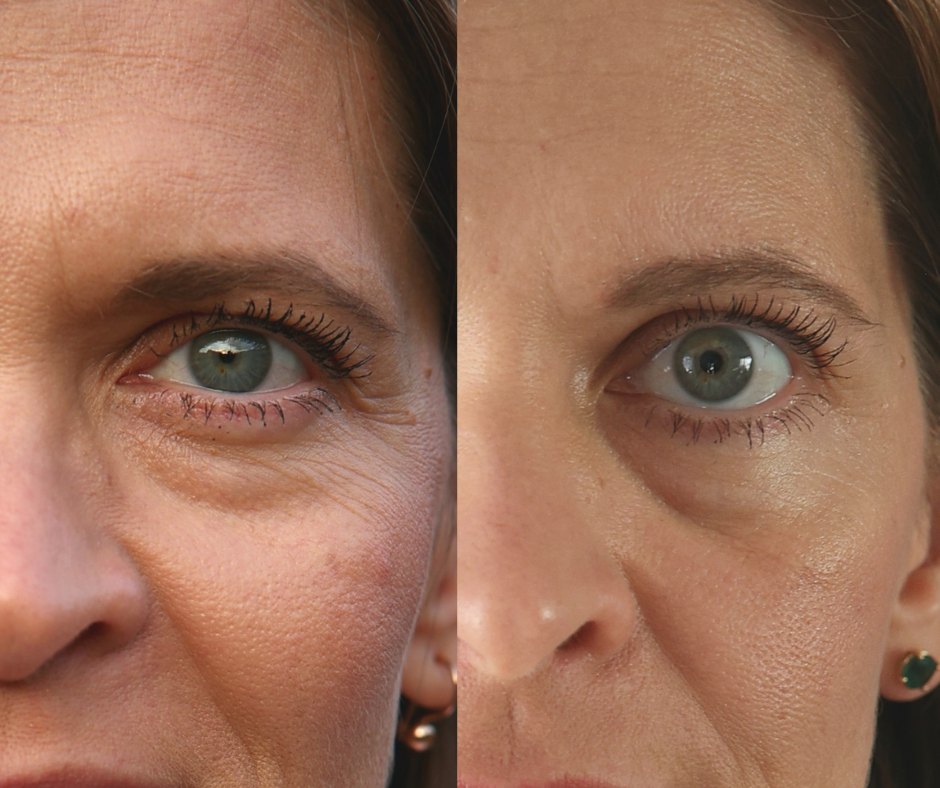
The under-eye is where polynucleotides are asked for most, and it is also where treating the wrong thing shows the most. Before anything is injected there it is worth knowing what actually causes a dark circle, because pigment, vessels, hollowing and thin skin need different answers and only one of them responds to this. It so it has its own detailed write-up: read polynucleotides for the under-eyes for what they do and do not do about dark circles, hollows and tired under-eye skin. And for what a realistic result looks like, two polynucleotides before-and-afters, read honestly sets out a real under-eye and a real face result, and how to judge one.
Not a rivalry, and often not a choice. Both improve skin quality by different mechanisms, polynucleotides by signalling repair, Profhilo by saturating the tissue with hyaluronic acid, which is precisely why they are often layered rather than picked between. Which of them, or both, and in what order, is a decision I take apart in full in Profhilo versus polynucleotides, and one that rewards knowing the materials well. Our Profhilo treatment page and skin boosters page compare them, and the polynucleotides treatment page is where to book.
Here is my opinion, and it rests on a real distinction rather than a mood. The established injectables work by addition or subtraction. A filler supplies a volume the face has lost; a toxin subtracts the muscle movement that folds the skin. Both are elegant, both have their place, and neither changes the biology of the tissue itself. They act on the face, and the skin is left as it was. Done heavily, that is also how people end up looking done.
Polynucleotides work at the level the literature calls bio-stimulation and regeneration: instead of supplying material ready-made, they are understood to prompt the dermal fibroblast's own anabolic function, its synthesis of collagen and extracellular matrix, and to improve the environment those cells work in, the hydration and the oxidative balance (expert consensus, PMID 32799391). The target is not the appearance of ageing but several of its actual drivers: fibroblast output, the matrix that holds the skin together, and the oxidative load that degrades both. That is a genuine change in what an aesthetic treatment is even aimed at, and I am convinced it is where the serious end of the field is heading. I would rather be early to that than expert in the old thing.
None of it is dramatic, and that is the sophistication of it. You are not buying a new face or a recovery. You are giving your own cells a reason to do more of what they have quietly stopped doing, and letting what returns be unmistakably yours.
If that is the skin you recognise, a consultation is where we work out whether polynucleotides are your starting point or whether the real problem is shape, and treat it accordingly.
Part of my job is knowing which of these tools will still make sense in ten years. Polynucleotides are one of them. If your skin has lost its quality rather than its shape, they are where I would start.
Polynucleotides are used on the scalp as well as the face, where they improve hair thickness rather than count, and combine with PRP to better effect than either alone. That is covered in the article on hair loss treatment.
However you begin, it starts with a conversation.
Book a consultation with Dr Beiki, or start free with an online assessment in your own time.
Rated 5.0 on Google · 30 reviews
Goodlight Wellness Center · Bath