One moment
Preparing the page.
Loading content…One moment
Preparing the page.
Loading content…Profhilo Structura is a firmer, high-concentration hyaluronic acid from the Profhilo family, designed to support the fat compartments of the lower face and jaw. It firms and supports rather than adding volume. No trial has yet put a figure on the size of the lift, so I describe what it does for the lower face rather than quoting you millimetres.


You have almost certainly met this treatment as a promise. Profhilo Structura, the injectable jawline lift, the one that firms the lower face without a knife, sometimes with a number bolted on: this many millimetres, this many months. That is the version doing the rounds, and it is the one I want to take apart with you before you book, because the honest science and the marketing part company at exactly that word, lift.
The person who looks this up is rarely chasing a dramatic change. You caught your jawline in a photo taken from below and it read softer than it used to. Not a line you can point to, more the loss of a clean edge that used to sit there on its own. You still recognise your face; it just seems to hold itself a little lower than the version you carry in your head. So the real question is simple: can the thing everyone calls a lift give you that edge back, or is it only sold well? Here is the honest answer, mechanism and all.
Structura belongs to the Profhilo family, and it is built on the same NAHYCO hybrid technology: high- and low-molecular-weight hyaluronic acid bonded together by heat rather than by a chemical cross-linker. What makes Structura different is its physics. It is a high-concentration hyaluronic acid, 45 mg, formulated to be firmer and more elastic, so that instead of spreading thinly through the skin to improve its quality, it can sit deeper and lend structural support.
And it is aimed at a target most descriptions skip: the fat compartments of the face. Your cheeks and jawline are held up, in part, by discrete pads of fat sitting in defined compartments. Early in facial ageing these begin to deflate and slip, and the lower face softens and descends before any single wrinkle appears. Structura is designed to support those superficial cheek compartments. The review that introduced it describes treating the two patterns you may recognise: early hollowing of the cheek pads ("sinkers") and jowl softening as those pads lose their hold ("saggers") (practical review, PMID 39028477).
That is the real mechanism, and it is more interesting than "a lift": not filling a line, not building a projecting volume, but supporting the scaffolding your lower face is quietly losing.
| Profhilo Structura | At a glance |
|---|---|
| What it is | A firmer, high-concentration hyaluronic acid (45 mg) from the Profhilo NAHYCO family |
| What it does | Supports the fat compartments of the cheeks and jaw so the lower face holds its edge, firming rather than filling |
| What it won't do | Add projecting volume, or deliver a measured, guaranteed "lift" |
| Best for | Early softening of the lower face and jawline; skin beginning to lose its own support |
| Course & upkeep | Usually two sessions, four weeks apart; typically maintained around six months |
| The honest limit | The mechanism is sound and the placement is anatomical; no trial has yet quantified the lift in millimetres (PMID 39028477) |
| Cost at Baudelaire | £375 single, £700 course of two |
Two faces age in two different ways, and Structura is aimed at both, for different reasons. Which one is yours is the first thing a good assessment settles, because it changes what the treatment can realistically do.
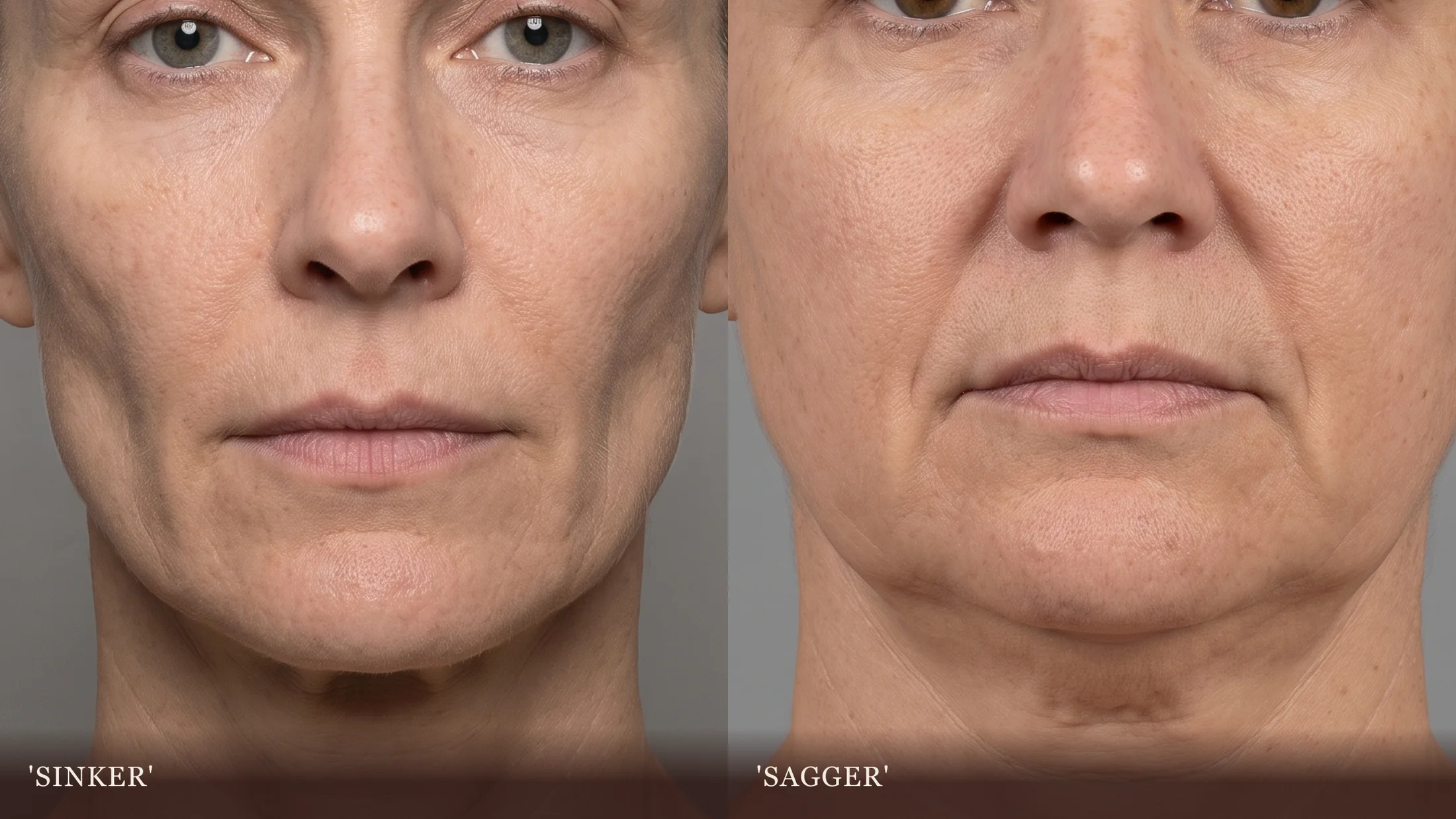
| 'Sinkers' | 'Saggers' | |
|---|---|---|
| The skin | Thinner, less dense, its cushion lost | Thicker and denser, but no longer well supported |
| What is happening | The fat pads deflate, so the bone begins to show, at the temples and under the cheekbone | Volume slides down and pools in the lower face; the lost support reads as laxity and a softening jaw |
| What Structura can do | Return some support and cushion to the deflating pads, so the face reads less hollow | Firm and re-support the pads that are sliding, so the lower face holds its edge |
Most faces are a mix, weighted one way or the other, and that weighting decides where the product goes and how much. It is also why "a lift" is the wrong word: on a sinker the gain is support and fullness returning to a pad that had deflated; on a sagger it is firmer support under tissue that had begun to descend. Neither is a surgical repositioning, and both respond best caught early, while the pattern is still forming.
Here is where I part company with the marketing, plainly. The claim being sold is a measurable, dependable lift you can quote back: so many millimetres, so many months. What actually stands behind Structura today is a practical review and expert consensus on how to use it (a description of what the product is designed to do and how to inject it well), not a randomised trial that has measured the size of the lift or how long it lasts (practical review, three experts convened by the manufacturer, PMID 39028477). There is one clinical study, and it should be here rather than absent: 22 volunteers, uncontrolled and unrandomised, in which soft-tissue thickness increased after injection and the improvement held across six months (case series, 22 patients, PMID 37623069). That is a real, measured result from a small and uncontrolled study. What no trial has done is put a number in millimetres on the lift, which is why I will not quote you one. The wider Profhilo hyaluronic-acid evidence supports better hydration, elasticity and skin quality in people; the specific promise of a quantified jawline lift, from Structura, is not yet there.
So the honest translation is this: the promise on offer is a number; the evidence supports a direction. That does not make it a poor treatment. The mechanism is sound and the product is well made. But you should walk in knowing you are buying well-reasoned support, not a measured facelift with a guarantee. Anyone quoting you millimetres is ahead of the science, and I would rather tell you that before you decide than after.
The word lift blurs four different things. Choosing well means knowing what each is actually for.
| Option | What it does | Best for |
|---|---|---|
| Classic Profhilo | Spreads through the skin to improve hydration, elasticity and quality | Tired, crepey skin (quality, not sag) |
| Profhilo Structura | Sits deeper to support the cheek and jaw fat compartments | Early softening of the lower face, without added volume |
| Dermal filler | Adds volume and projection to a specific place | A flattened cheek or receded jaw you want built up |
| Surgery (lower facelift) | Repositions and removes tissue | A significantly descended lower face; the largest, most durable change |
Read down that table and Structura's place is clear: it is the option for a lower face that has begun to soften and lose support, in someone who does not want added volume, a changed shape, or an operation.
Structura suits the person in between. Your lower face is softening and losing its own support, you want it to hold its edge better, and you do not want volume added or your shape changed. On early jowling and an under-supported jawline, that is exactly the brief it was built for.
It is the wrong tool if you want a dramatic, measurable lift, because the evidence does not support that magnitude, whatever the framing promises. It is the wrong tool for adding projection to a flat cheek or a receded chin; that is a filler's job. And it is no substitute for surgery where a lower face has descended significantly. A surgical lift does more and lasts longer, and I will say so in the room rather than sell you a course that cannot reach it.
Structura is not spread thinly across the skin the way classic Profhilo is. It is placed deep, in a few defined deposits over the superficial fat compartments of the cheek, the pads that sit in front of the ear and run down toward the jaw.
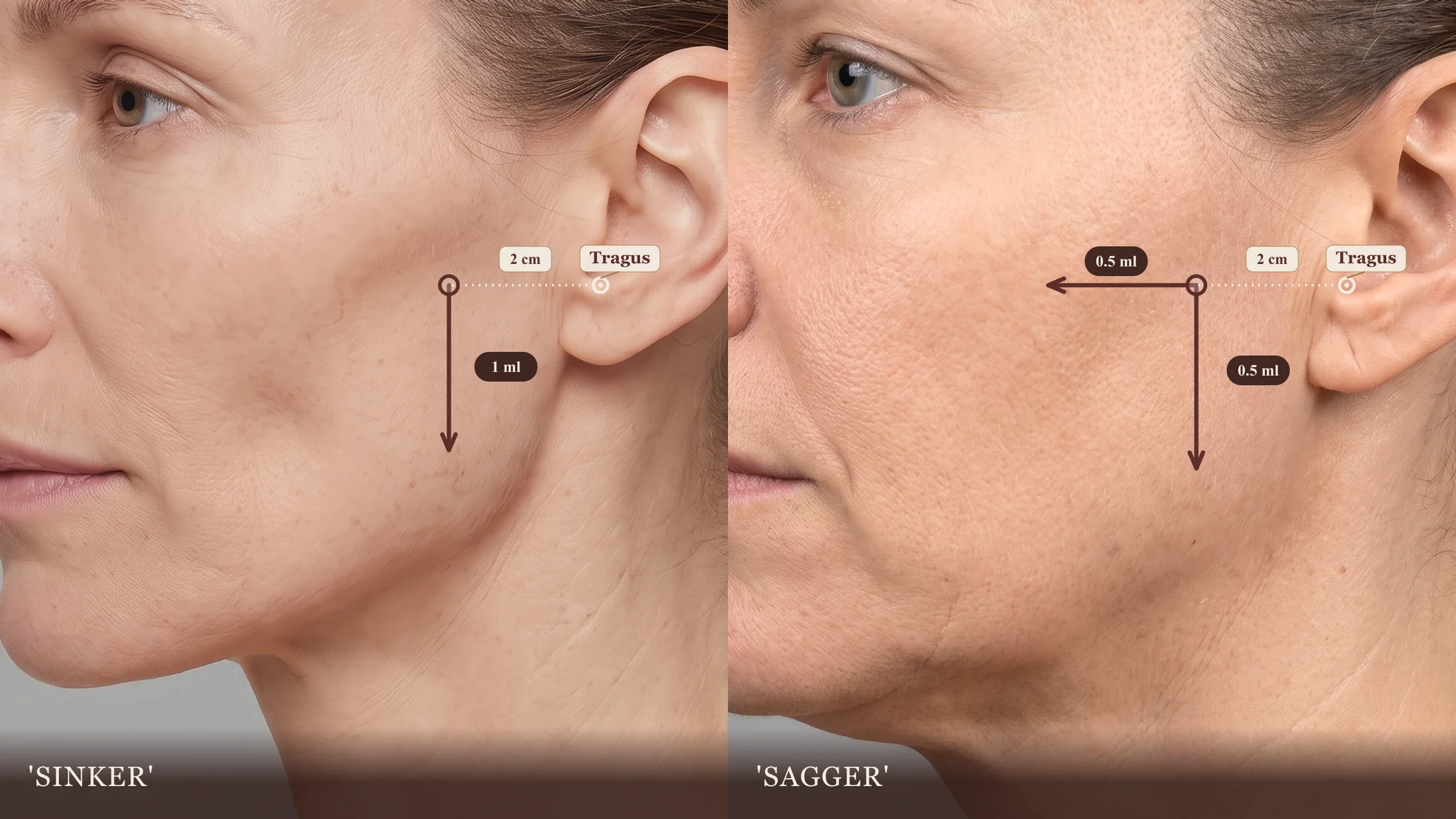
The points are measured from the tragus, the small cartilage flap in front of the ear, so the injector reaches the right compartment at the right depth: a small volume, often around a millilitre a side, fanned into the pads that have lost their support. The pattern follows your face, higher on the cheek for a sinker, lower and along the jaw for a sagger.
The precision is the whole point. These pads sit over the major vessels of the mid-face, so the map is not a formality. It is the difference between a natural result and a poor one, and it is why the hand giving the injection matters far more here than the product in the syringe.
Structura is given as a short course, usually two sessions about four weeks apart, then maintained. The effect builds over the weeks after the second session rather than arriving on the day, and it is typically topped up around every six months, though the exact interval is judged at review rather than promised, because a trial-established duration does not yet exist. You may see small injection points and short-lived swelling or bruising, and most people return to normal the same day. At Baudelaire in Bath, Structura is £375 for a single session and £700 for the recommended course of two. The course is the honest starting point, because the result is built across both.
The fullness of a young lower face is not volume you can pour back in; it is living tissue, fat held in defined compartments that soften and slip as we age. Structura is not a filler placed into a space. Its concentrated hybrid HA is formulated to restore that tissue itself, in the very compartments that go first. That is the real secret of a natural result: you are not adding a foreign shape, you are rebuilding the scaffold your own face was built on.
Dr Dana BeikiIf your lower face has begun to soften and you want it supported, without volume, surgery, or a story about millimetres, Structura is a well-reasoned choice, provided you go in knowing exactly what the evidence does and does not promise. Which compartments have actually softened, and whether Structura or a filler or something else fits your face, is a reading, and that reading is what a consultation is for.
However you begin, it starts with a conversation.
Book a consultation with Dr Beiki, or start free with an online assessment in your own time.
Rated 5.0 on Google · 30 reviews
Goodlight Wellness Center · Bath