One moment
Preparing the page.
Loading content…One moment
Preparing the page.
Loading content…Rosacea is not one condition with one treatment. It is a set of features that appear in different combinations, and the feature you have decides what works. Visible thread veins and persistent redness are structural, living in permanently dilated vessels that no cream can reach, and these are what the Nd:YAG laser treats by heating the blood inside them until the vessel collapses and clears. Papules and pustules are a different problem with stronger evidence behind topical treatment. Identify the features first and the results are good: discrete vessels clear well, background redness settles over a course, and your face stops being the first thing you think about in a warm room.
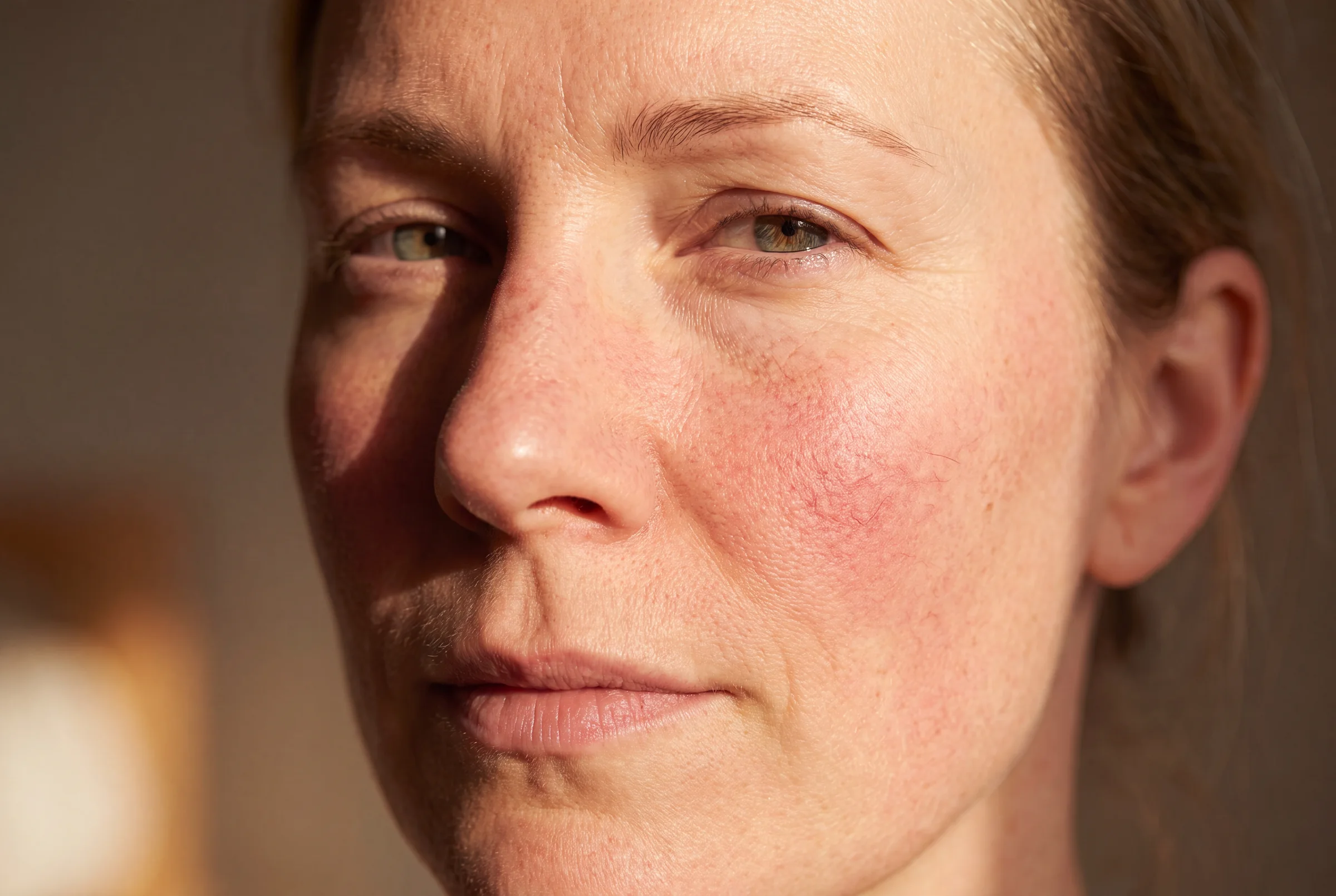
There is a moment people describe almost identically. You walk into a warm room, or drink half a glass of wine, or step off a cold street into a shop, and you feel it arrive before anyone sees it: the heat rising across the cheeks and the nose, and the certainty that your face has just announced something you did not authorise.
Then, at some point, it stops leaving. The flush that used to fade after twenty minutes becomes a background colour. Fine vessels appear at the sides of the nose and across the cheeks, and they do not go anywhere.
That progression has a name, and more importantly it has parts. The single most useful thing to understand about rosacea is that it is not one condition with one treatment. It is a set of features that occur in different combinations in different people, and the feature you have decides the treatment that works. Get that sorting right and the results are good. Get it wrong and you can spend a great deal of money on the wrong tool.
For years rosacea was divided into subtypes and patients were assigned to one. That approach has been formally abandoned. International consensus panels and the current guidance now use a phenotype-led approach: you treat the features a person actually presents with, rather than fitting them to a category (global consensus, PMID 27861741; updated consensus, PMID 31392722).
The reason is simple. The old subtypes conflated features that behave differently, and most people have more than one. A meta-analysis of 39 studies covering 9,190 patients found the features overlap substantially: persistent redness with visible vessels in around 57 per cent, papules and pustules in around 43 per cent, eye involvement in around 11 per cent, and thickening of the skin of the nose in around 7 per cent, the last being more common in men (meta-analysis, PMID 35385049).
Those percentages add up to well over 100 for a reason. People have combinations. So the question is never "which type of rosacea am I?" It is "which of these features do I have, and in what proportion?"
The features worth naming, because each has a different answer, and the clinic's overview of the condition itself sits on the rosacea page:
They get confused constantly, including by people who have had both, and the distinction changes the treatment entirely.
Acne begins with a blocked follicle: comedones, meaning blackheads and whiteheads, are its signature. Rosacea does not produce comedones. Its papules and pustules arise on a background of persistent redness, usually across the central face, without the blocked pores that define acne. That is the practical tell: if there are blackheads, think acne; if the bumps sit on a red background with no blackheads, think rosacea.
It matters because the treatments diverge, and some acne routines actively worsen rosacea by stripping an already impaired barrier. If your concern is genuinely acne, and particularly if it has left indentation behind, that belongs in the article on acne scarring instead.
Rosacea is not sensitivity, and it is not something you caused. It is a disorder of the innate immune system and the nerves and vessels of facial skin, in people who are genetically susceptible.
Two mechanisms matter for understanding treatment. The first is neurovascular. Rosacea-affected skin overexpresses a family of receptors, including TRPV1, that respond to heat and to chemical stimuli. When they are triggered, sensory nerves release vasoactive neuropeptides including substance P, which dilate vessels and drive neurogenic inflammation. Affected skin has a measurably lower threshold for heat and chemical stimuli than unaffected skin, which is precisely why the same glass of wine or warm room does to your face what it does not do to other people's (review, PMID 38260914).
The second is immune and vascular remodelling. Rosacea skin overproduces an antimicrobial peptide called cathelicidin, processed into an inflammatory fragment by an enzyme found at abnormally high levels in these patients. That fragment amplifies inflammation and promotes new vessel growth (review, PMID 40149947). Both of those sources are narrative reviews rather than trials, so treat the detail as the current working model. The consequence, though, is visible and not in dispute: vessels dilate, then proliferate, and eventually stay dilated. The redness stops being an event and becomes a structure.
That is the pivot on which the treatment turns. Once redness is structural, meaning it lives in vessels that are permanently dilated, no cream will reach it, because a cream cannot remove a vessel. Equally, a laser aimed at vessels will not calm an inflammatory papule. Different problems, different tools.
This is the part usually skipped, and it is where the honest picture is genuinely useful, because the strength of evidence differs sharply between features. The following comes from the British Journal of Dermatology's systematic review, which graded the certainty of each finding (GRADE systematic review, PMID 30585305).
| Your feature | Best-evidenced treatment | Certainty of evidence |
|---|---|---|
| Papules and pustules | Topical azelaic acid, topical ivermectin | High |
| Persistent redness, temporary relief | Topical brimonidine gel | High, but transient |
| Persistent redness and visible vessels | Long-pulsed dye laser, Nd:YAG laser, intense pulsed light | Low to moderate |
| Flushing alone | No randomised trials available | None |
| Maintenance after control | Topical metronidazole, ivermectin, azelaic acid | Effective and safe |
Read that table properly, because it contains three things worth acting on.
If your main problem is papules and pustules, the best-evidenced treatment is a cream, not a laser. Topical azelaic acid and ivermectin reduce lesion counts with high-certainty evidence. That is stronger evidence than exists for any laser in this condition. If you come in with inflammatory bumps and someone sells you a course of laser as the primary answer, they are not following the evidence. We would treat the papules medically first.
If your main problem is visible vessels and persistent redness, laser is the right family, and that is what we do here. The certainty is low to moderate rather than high, and I would rather tell you that than imply otherwise. It is still the best available option for a structural problem that topicals cannot reach.
Brimonidine is worth knowing about, and worth understanding the limits of. It constricts vessels and reduces redness within about half an hour, peaking a few hours later, after which the effect wears off and the redness returns to baseline. It is genuinely useful before an event. It treats nothing.
The vascular work here is our rosacea and vascular treatment, which uses the Nd:YAG at 1064 nm on the Fotona platform, the same wavelength described in the resurfacing article.
The principle is selective absorption. That wavelength is poorly absorbed by water, so it passes through the surface, and it is absorbed by haemoglobin, which is inside the vessel you want to treat and not in the tissue around it. The energy heats the blood, the vessel wall is damaged, the vessel collapses and is cleared by the body over the following weeks. That collapse-and-clear is what facial thread vein removal actually is: not erasing a mark on the surface, but closing the vessel underneath it. The skin above it is left intact, which is why there is no meaningful downtime.
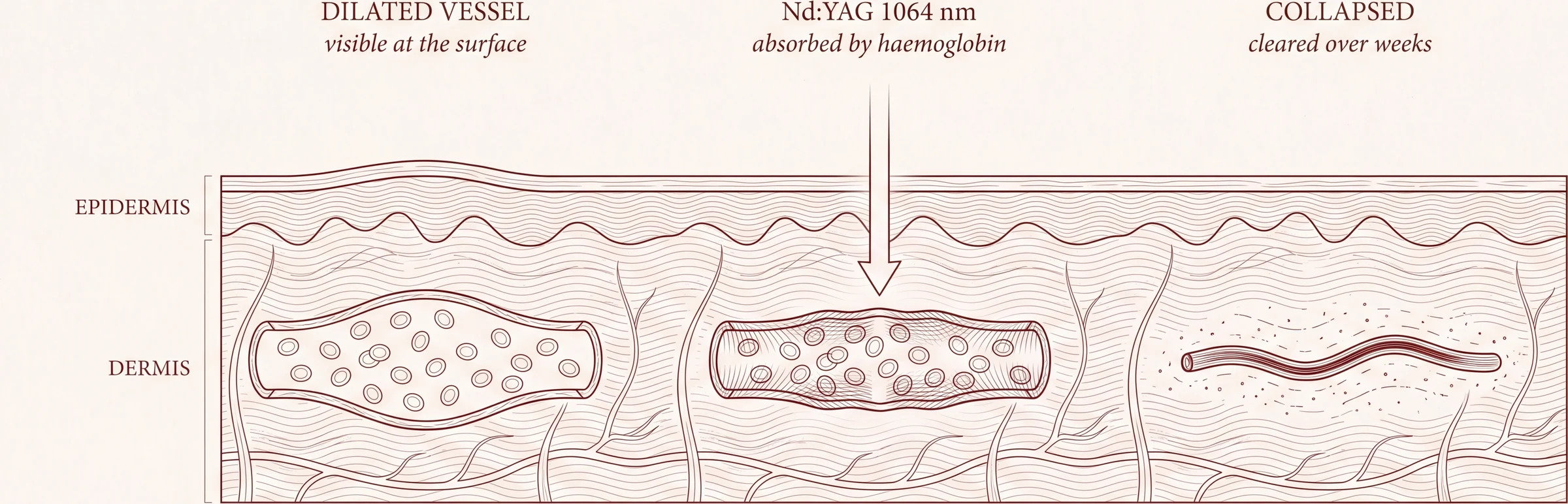
Its long wavelength also means it penetrates deeper and is less absorbed by melanin than shorter vascular wavelengths, which is what gives it an established safety record in richly pigmented skin where other vascular devices become risky.
There is a further finding worth knowing, because it suggests the laser is doing more than removing plumbing. In a comparison against pulsed dye laser in patients with redness and visible vessels, the Nd:YAG achieved excellent response in around 73 per cent of patients against around 53 per cent, and it produced a greater fall in substance P, the neuropeptide implicated in rosacea's neurogenic inflammation (comparative study, PMID 23992160). If that holds, treating the vessels may also quieten some of the signalling that keeps provoking them.
Redness that comes and goes is a signal. Redness that stays is a structure. The first responds to changing what provokes it, the second responds to treating the vessel, and knowing which one you are looking at is most of the work.
Dr Dana BeikiThis is the expectation worth setting precisely, because it is where satisfaction is won or lost.
Discrete visible vessels, the fine red lines at the sides of the nose and across the cheeks, are the best target this treatment has. This is what people mean by thread vein removal: they are a defined structure containing the exact chromophore the wavelength is tuned to, so they can be targeted individually and cleared, and they respond well.
Diffuse background redness, the general flush across the cheeks with no individual vessel to aim at, improves more modestly and more slowly. There is no single structure to collapse; you are reducing the overall vascular load over a course.
And pure flushing, the transient heat that comes and goes with triggers, is the least responsive of the three. It is a nerve and reflex phenomenon as much as a vascular one, and there are no randomised trials supporting any intervention for it specifically. Managing it is mostly about the threshold, which is the next section.
So if you arrive with thread veins, expect to be pleased. If you arrive with diffuse redness, expect gradual improvement over a course. If you arrive with flushing alone, we should talk before you book anything.
Because affected skin has a lower threshold for heat and chemical triggers, a real part of managing rosacea is keeping the threshold from being crossed unnecessarily.
The common provocations are consistent: heat in any form, including hot drinks, hot rooms and hot baths, sun exposure, alcohol, spicy food, abrupt temperature changes, and stress. Ultraviolet exposure deserves particular attention, being both a trigger and a driver of the vascular damage underneath.
None of this is a moral instruction, and I am not going to tell you never to drink wine again. The useful version is knowing your own provocations, which are individual, and deciding which ones are worth it. Daily sun protection is the one I would not negotiate, because it protects the result you have paid for.
Skincare matters more here than in most conditions, because the barrier is impaired in rosacea skin and a damaged barrier makes everything worse. Simple, bland, fragrance-free, and nothing that stings.
It suits someone whose redness has become structural: visible vessels, a background flush that no longer fully fades, and a face that reads as red in photographs regardless of how they feel that day.
It suits someone who wants the visible part treated while the condition itself is managed. Those are different jobs and both are legitimate.
It does not suit someone whose dominant feature is papules and pustules, who should be treated medically first, on much stronger evidence. It does not suit active infection or inflammatory flare in the area at the time of treatment. And if your eyes are gritty, dry or persistently irritated, that is ocular involvement, it is common, and it needs proper assessment rather than a facial laser.
One thing to be clear about. This is a chronic condition and treatment manages it rather than curing it. Vessels that are treated are gone for good, but rosacea will continue to produce new ones at its own pace, so most people have periodic maintenance. Anyone offering a permanent cure is describing something the condition does not do.
If you are not certain which features you actually have, that is exactly what the first appointment is for. A consultation at the clinic in Bath is free and commits you to nothing. We photograph properly, identify which features are present and in what proportion, and I tell you plainly which of them a laser will move, which need a topical, and which need referral rather than treatment here.
Expect your face to stop being the first thing you think about in a warm room. That is what people describe: not a different face, but the end of a low-level vigilance about lighting, temperature and photographs. Discrete vessels clear well. Background redness settles over a course. The face looks like it is not reacting to anything, which is the whole point.
Two things to hold in view. This is management of a chronic condition, so periodic maintenance is part of the arrangement. And the features respond unequally, which is why we identify them individually before treating any of them.
What we are doing is precise. Choose the wavelength that haemoglobin absorbs and the surrounding tissue does not, deliver it to a vessel that is permanently dilated, collapse it, and let the body clear it. Treat the papules medically because that is where the stronger evidence sits. Protect the barrier and lower the provocations, so the vessels we have not treated are under less pressure to appear. Redness is not one problem, and it is not solved by one instrument.
If what you are seeing is brown rather than red, that is pigmentation rather than a vascular problem, and it sorts by type in its own way. That is covered in the article on pigmentation, sun spots and melasma.
However you begin, it starts with a conversation.
Book a consultation with Dr Beiki, or start free with an online assessment in your own time.
Rated 5.0 on Google · 30 reviews
Goodlight Wellness Center · Bath