One moment
Preparing the page.
Loading content…One moment
Preparing the page.
Loading content…Lip filler is hyaluronic acid, a gel of a sugar your body already makes, injected to add volume, shape and hydration to the lips. It is temporary and reversible: it softens over months as your body breaks it down, and can be dissolved with an enzyme if you want it gone. A meta-analysis found it effective for lip augmentation, with about half of patients still fuller at a year. Done with restraint and anatomy, it enhances your own lips rather than changing them.

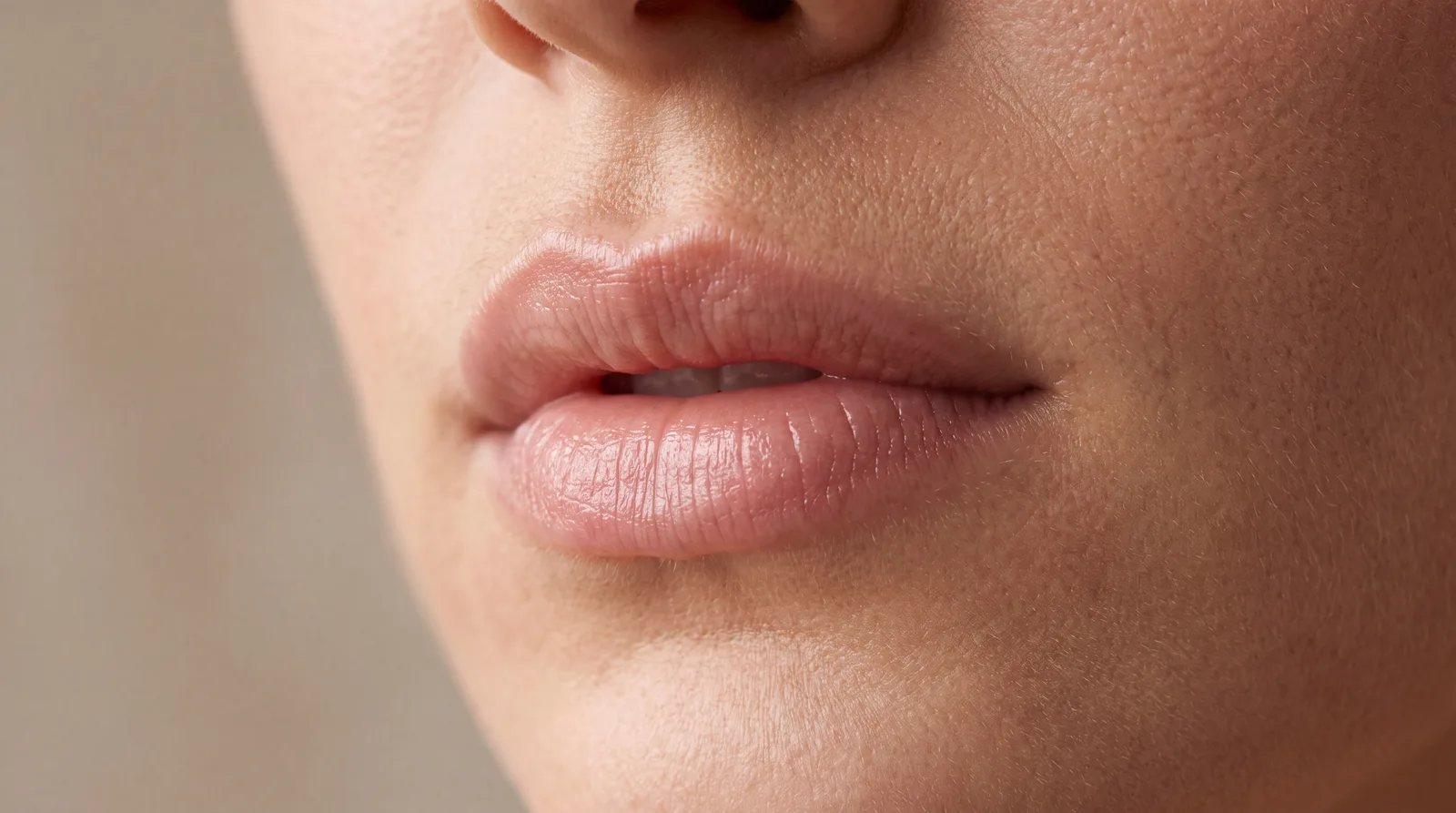
Almost everyone who asks me about lip filler asks the same thing first, in one form or another: will people be able to tell. It is the right question, and the honest answer is that with good lip filler, they cannot. The versions you can spot, the overfilled top lip, the sausage-roll, the filler that has wandered above the lip line, are not what the treatment does. They are what it does when it is overdone. Done properly, lip filler gives you fuller, better-defined lips that still read, unmistakably, as yours.
Lip filler is hyaluronic acid, a gel of a sugar your body already makes, injected to add volume, shape and hydration to the lips. It is temporary and reversible: it softens over months as your body breaks it down, and it can be dissolved with an enzyme if you ever want it gone. A meta-analysis found it effective for lip augmentation, and the whole craft of it is judgement, knowing your anatomy and knowing when to stop.
| Key fact | The honest answer |
|---|---|
| What it is | Hyaluronic acid, a soft cross-linked gel of a sugar your body already makes. |
| What it does | Adds volume, shape and hydration, and defines the border and cupid's bow so lips still read, unmistakably, as yours. |
| How long it lasts | Several months to around a year; about half of patients still meaningfully fuller at twelve months. |
| When it settles | Swelling for the first two or three days, then the real result at about two weeks. |
| Downtime | Minor and expected: swelling, tenderness and bruising for a few days. |
| Reversible? | Yes, it can be dissolved with hyaluronidase if overfilled, migrated or unwanted. |
| What it won't fix | Fine lines and crepiness around the mouth, which are a skin-quality problem, not a volume one. |
The filler used in reputable clinics is hyaluronic acid, the same water-binding molecule your skin and lips already contain. It is manufactured into a soft gel and cross-linked, meaning the chains are lightly bonded together so the gel holds a shape and lasts, rather than dissolving within days. Different products are firmer or softer depending on how they are made, which is why the right one for a subtle border is not the right one for adding body. At Baudelaire I use the Juvederm range, a well-established family of hyaluronic acid fillers, and choose the specific product to the lip in front of me: a softer one for hydration and a clean border, a firmer one where a little more body is wanted.
Two things follow from it being hyaluronic acid, and both matter. It is a temporary filler: your body breaks it down over months, so the result is never permanent (hyaluronic acid classed as a temporary, reversible filler, PMID 39483115). And it is reversible on demand: if it is overfilled, migrated, or simply not what you wanted, it can be dissolved with an enzyme called hyaluronidase. That is a level of safety and control no permanent filler can offer, and it is the main reason hyaluronic acid became the standard for lips.
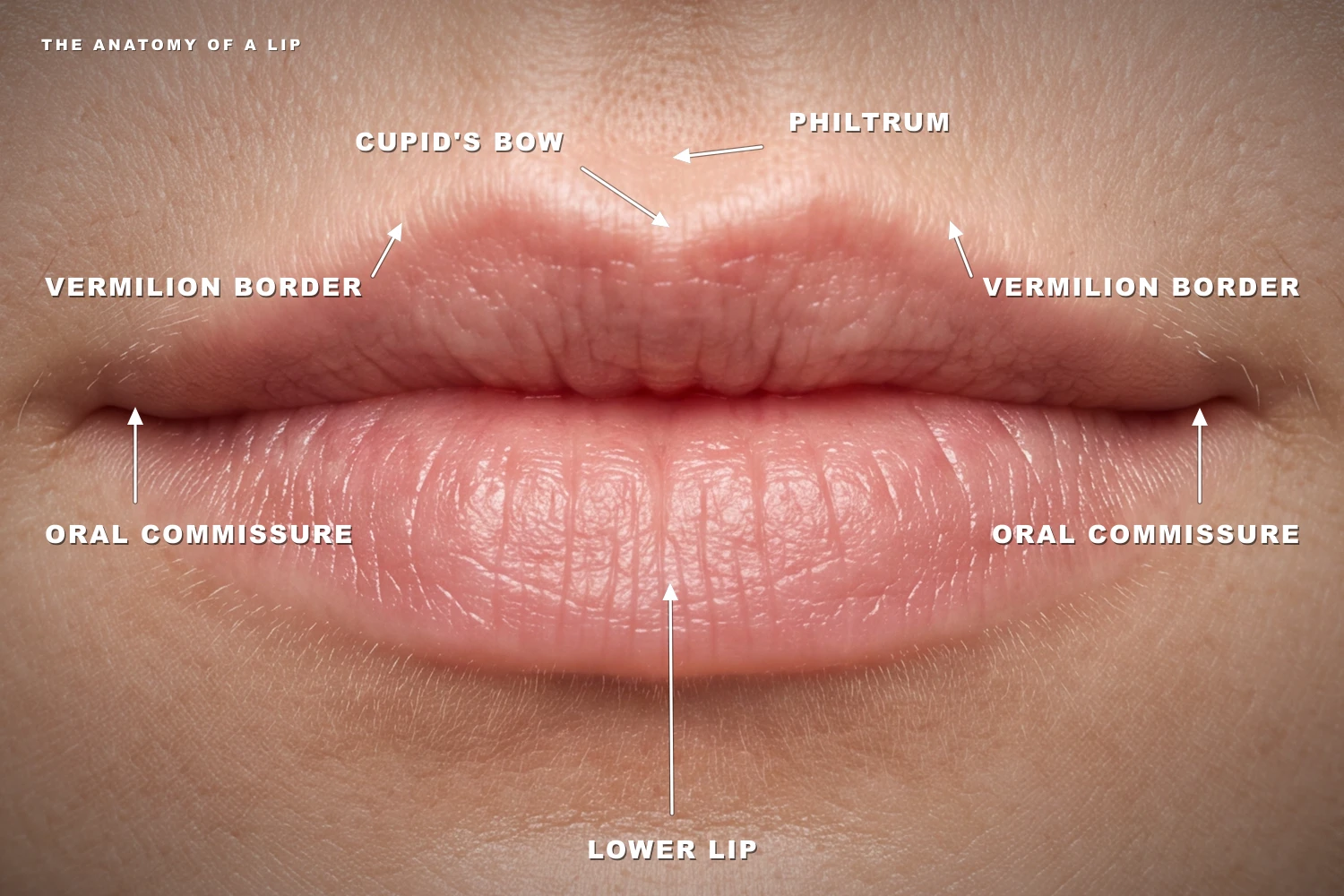
Lips are not a balloon you inflate. They have a structure: the vermilion border that outlines them, the cupid's bow at the centre of the upper lip, the philtral columns running up to the nose, and a natural balance in which the lower lip carries a little more volume than the upper. A good result works with that structure, restoring or enhancing it. A poor one ignores it and just adds volume, which is exactly how a lip starts to look done.
This is why the same syringe in two pairs of hands gives two different faces. The product is close to a commodity; the anatomy and the restraint are not. Placed by the border and the bow, filler defines and freshens. Pushed in for volume alone, past what the lip can carry, it rolls forward and outward, and that is the look everyone is afraid of.
This is the most asked question about the treatment, so here is the honest, evidenced answer. Lip filler is temporary because hyaluronic acid biodegrades. In the largest analysis of the evidence, lips were still meaningfully fuller in about half of patients at twelve months, with the effect fading in the rest over the year (meta-analysis of HA lip augmentation, PMID 34422892). So a fair expectation is several months to around a year from a treatment, not longer, and lips move and eat and talk all day, which is part of why they clear faster than filler in stiller areas of the face.
How long yours lasts depends on your metabolism, the product, how much was placed and where. Firmer, more cross-linked gels last longer; a small, natural amount fades sooner than a fuller result. Topping up before it has fully gone, rather than rebuilding from nothing each time, is usually how a natural look is maintained.
The hardest skill in lip filler is not adding volume. It is knowing when to stop. Anyone can make a lip bigger; the judgement is in making it bigger and still, unmistakably, yours.
Dr Dana BeikiAlmost no one truly wants "bigger lips." They want something specific, and the useful consultation is the one that finds out what. Bigger is rarely the answer; balance, definition and restoring what you used to have almost always are. Here is how the concerns I hear most often translate into what I would actually do.
The through-line in all of these is restraint. You can always add a little more at a review; the harder job, and the one that protects the result, is knowing where to stop.
Hyaluronic acid lip filler has a good safety record in trained hands, but it is a medical procedure and not free of risk, and you should hear the real list rather than a reassuring blur (lip filler is effective but carries adverse reactions, PMID 39483115). The common effects are minor and expected: swelling, tenderness and bruising for a few days, and small lumps that settle as the filler beds in.
The serious risk is rare and worth understanding: the lips are supplied by the labial arteries, and filler accidentally placed into a vessel can block it, which is why lip filler should be done by someone who knows the anatomy and what to do if it happens (lip and perioral vascular anatomy in filler injection, PMID 40003724). It is uncommon, it is why the injector matters far more than the price, and it is another reason the reversibility of hyaluronic acid is such an advantage.
Two things a careful injector does to lower that risk are worth knowing, because you are allowed to ask about both: using a blunt cannula rather than a sharp needle where the lip allows, and drawing back on the syringe before injecting to check the tip is not sitting in a vessel. Be clear what the second one is worth, because it is widely oversold. International consensus strongly recommends aspirating before injection, especially in high-risk areas, and is equally explicit that while blood appearing is reason to stop and reposition, a clean result does not rule out being in a vessel (global aesthetics consensus, PMID 27219265). What protects you is where the needle goes, not what the syringe says. And the signs worth memorising, because catching them early is what makes them treatable: skin around the lips turning white, blotchy or dusky, pain that grows rather than fades over the hours after treatment, or a patch that feels cold. Any of those means you call your injector at once, not in the morning, and a good clinic keeps the antidote, hyaluronidase, in the room precisely so a problem can be reversed on the spot.
Expect your lips to look bigger and feel firm for the first two or three days from swelling, not from the filler itself, then to settle over about two weeks to the real result. For the first day or two, it is sensible to avoid heat, hard exercise, alcohol and anything that flushes the face, since all of them worsen swelling and bruising. Gentle is the rule, and the final shape is the one you judge at two weeks, not the one in the mirror that evening.
If you were someone I love, here is what I would tell you that no price list ever will.
You will love it on day three and doubt it at week two. The early swelling that looks perfect is not the result; it settles, and the true lips are a little less. Almost everyone feels that dip of doubt, and it is the most dangerous moment in the whole treatment, because it is when people go back and ask for more. Wait. What you have at two weeks is what you actually have.
Hyaluronic acid pulls water into itself, so your lips keep drinking for a fortnight and look fuller than the amount placed alone would explain. It is another reason the honest amount is less than you think on the day, and why a good injector deliberately leaves you wanting a fraction more rather than a fraction less.
The filler is nearly a commodity; you are paying for judgement. The same syringe in two pairs of hands gives two different faces. What you are buying is someone who knows where not to inject, when to stop, and what to do in the rare moment something goes wrong, which is exactly why unusually cheap lip filler is a warning rather than a saving.
Ask what they would refuse to do. A portfolio is anyone's best day. The more revealing question is what they turn away and whether they would tell you no, because an injector who agrees to everything is selling, not treating.
One area is usually already doing enough. In most mouths the lower lip is naturally the dominant one, and the instinct to plump both equally is how lips start to look heavy. Often the honest work is on the top lip alone, to bring the two into balance, and a good injector will treat less than you expected rather than more.
Give it two clear weeks before anything that matters. A few days of swelling, and sometimes a bruise, is ordinary rather than a complication. Do not have your lips done the week of a wedding, yours or anyone else's.
None of this is meant to put you off. It is meant to make you a harder patient to sell to, and the harder-to-sell patient is, almost always, the one who ends up with lips nobody can tell are done.
Lip filler suits someone who wants their own lips fuller, better defined or rebalanced, and who is comfortable with a temporary, gradual approach. It is not for anyone chasing a specific celebrity's mouth onto a different face, and I will say so. It is not done in pregnancy or while breastfeeding, as a precaution rather than because harm is proven, since the treatment is elective and the data do not exist. And if your lips have simply thinned with age as part of a wider change in the face, lip filler may be one part of the answer, alongside dermal filler elsewhere on the face, rather than the whole of it. What filler does in the cheeks is a different job from what it does in the lips, and reading both is the fastest way to work out which one you actually want.
If you are weighing whether lip filler suits your face, a consultation is where we look together in front of a mirror and decide honestly what would suit you and where the line should be.
Lip filler is probably the most over-done treatment in aesthetics, which is exactly why it rewards being done well. The product is ordinary; the judgement is everything, what suits your face, how much it can carry, and where to stop before it stops looking like you. Get that right and no one sees filler. They see a mouth that looks rested, balanced and a little fuller, and they assume you have simply slept well.
Bring me the lips you are picturing, and I will tell you in millimetres what your face can carry and where fuller would stop reading as you. Anyone can fill a lip; the craft is knowing exactly where to stop, and that is the part I have spent years getting right.
However you begin, it starts with a conversation.
Book a consultation with Dr Beiki, or start free with an online assessment in your own time.
Rated 5.0 on Google · 30 reviews
Goodlight Wellness Center · Bath