One moment
Preparing the page.
Loading content…One moment
Preparing the page.
Loading content…Pigmentation is not one condition, and the type you have decides the treatment, because the laser that clears a sun spot can make melasma worse. Sun spots and general sun damage are discrete, superficial and the best target laser has. Melasma is deeper, hormonal and chronic, and is treated first with topicals and rigorous sun protection, not laser. Post-inflammatory marks fade on their own with time and sun protection. Identifying which kind you have, under proper light before anything is aimed at your face, is the whole of getting a good result.

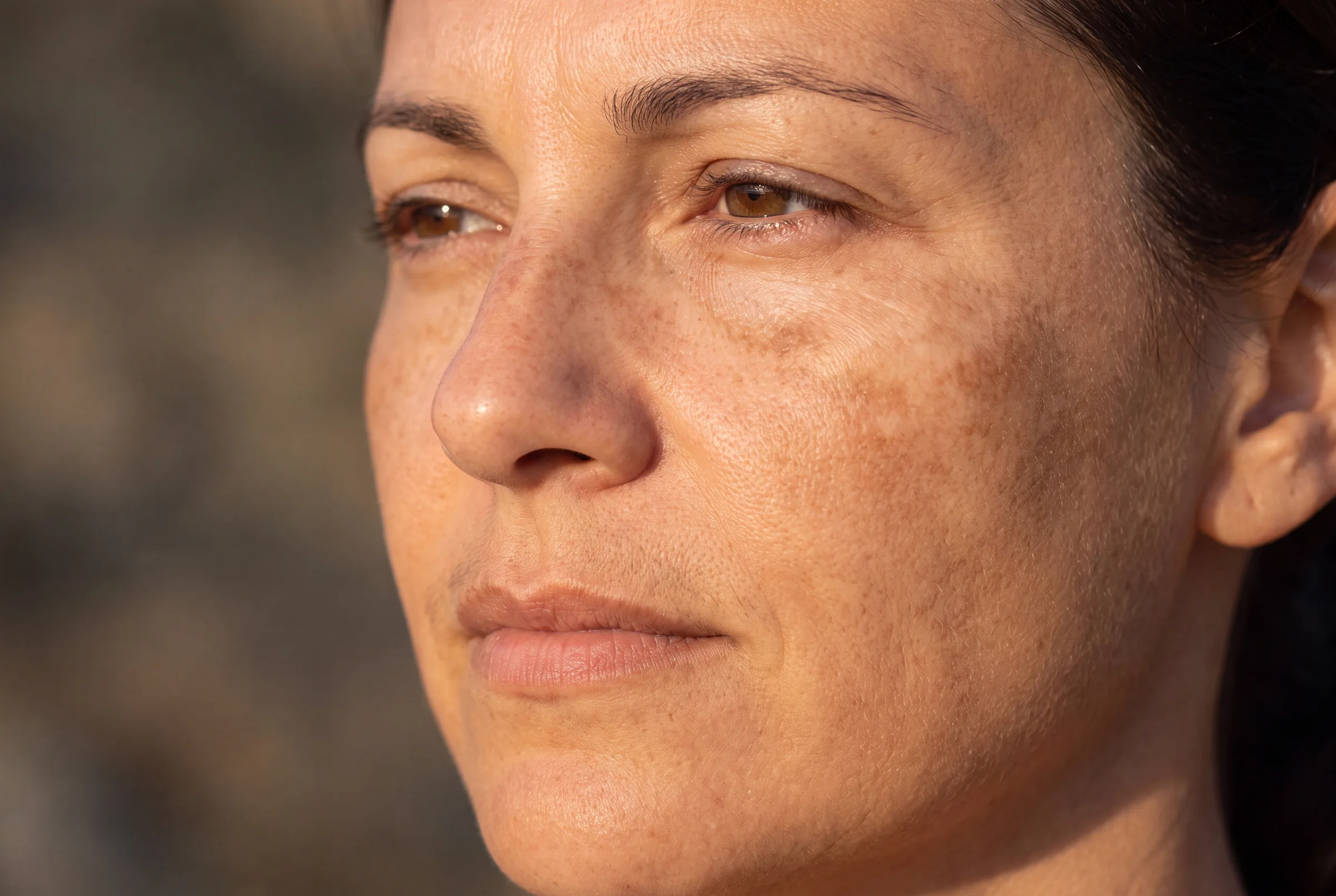
You notice it in a photograph, usually. Not a line or a sag, but a patch: a brown shadow on the cheek that the other cheek does not have, a scatter of spots across the tops of the cheeks and the bridge of the nose, a smudge above the lip that reads like a shadow even in flat light. You start angling away from it, and reaching for a heavier foundation.
Here is the thing almost nobody is told, and it is the thing that determines whether treatment helps you or makes you worse. Pigment is not one condition. It is several, they look alike to the eye, and the treatment that clears one of them can worsen another. The most powerful laser for a sun spot is capable of making melasma darker. So the entire game is working out which kind you actually have before anything is aimed at your face.
Get that right and pigment is one of the more rewarding things to treat. (If you want the clinic's overview of the condition rather than the science behind treating it, that sits on the pigmentation page.) Get it wrong and you spend money to make the problem more stubborn than it started.
Pigment problems divide by two questions: what caused the melanin, and how deep it sits. Those two things decide what will move it.
The single most useful clinical act in this whole area is telling these apart, which is done under proper light and magnification, sometimes with a Wood's lamp to see how deep the pigment goes. A melasma treatment plan and a sun-spot treatment plan are not variations on a theme. They are close to opposites.
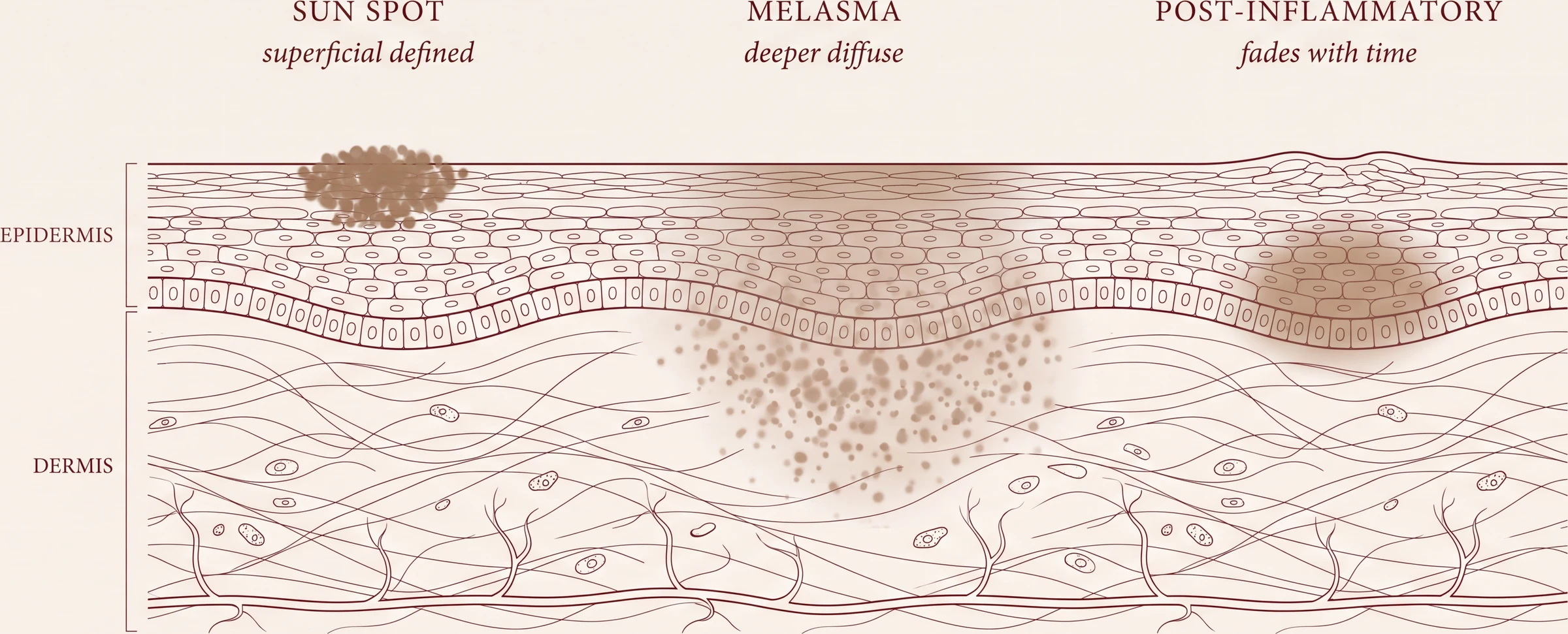
A short piece of biology makes the rest of this make sense, because every pigment problem is a variation on one process.
Colour in skin comes from melanin, made by specialised cells called melanocytes that sit at the base of the epidermis. Melanin is not a flaw. It is the skin's sunscreen: melanocytes package it into granules and hand it up to the surrounding skin cells, where it forms a cap over each cell nucleus and absorbs ultraviolet light before it can damage the DNA beneath. When skin is exposed to sun, melanocytes make more of it. That is a tan, and it is the system working as designed.
Pigment problems are that same protective system running unevenly or in overdrive. In a sun spot, years of exposure have left a cluster of melanocytes locally overproducing. In melasma, hormones and heat and light together drive a diffuse, persistent overproduction that the skin will not switch off. In a post-inflammatory mark, injury has triggered a burst of melanin that lingers after the injury has healed. Same pigment, same cells, different trigger and different depth, which is exactly why the treatments differ.
That also explains the two facts that govern everything below. Ultraviolet light is upstream of all of it, which is why sun protection is not optional. And the pigment sits at different depths depending on cause, which is why depth, not just colour, decides what can reach it.
For discrete, sun-driven pigment sitting in the upper skin, energy-based treatment does what creams struggle to.
The principle is the one described in the resurfacing article: selective absorption. Melanin absorbs certain wavelengths of light strongly, so energy can be deposited into the pigment and converted to heat, breaking it up so the body can clear it or lifting it away in the healing that follows. In a direct comparison in photoaged skin, the ablative fractional Er:YAG outperformed a non-ablative laser on both pigmentation and uneven tone (double-blind RCT, PMID 26417998). The mechanism is visible under the microscope: after treatment the pigment gathers into microscopic debris in the upper skin, which then migrates up and sheds over the following days, taking the discolouration with it (mechanism study, PMID 40536161).
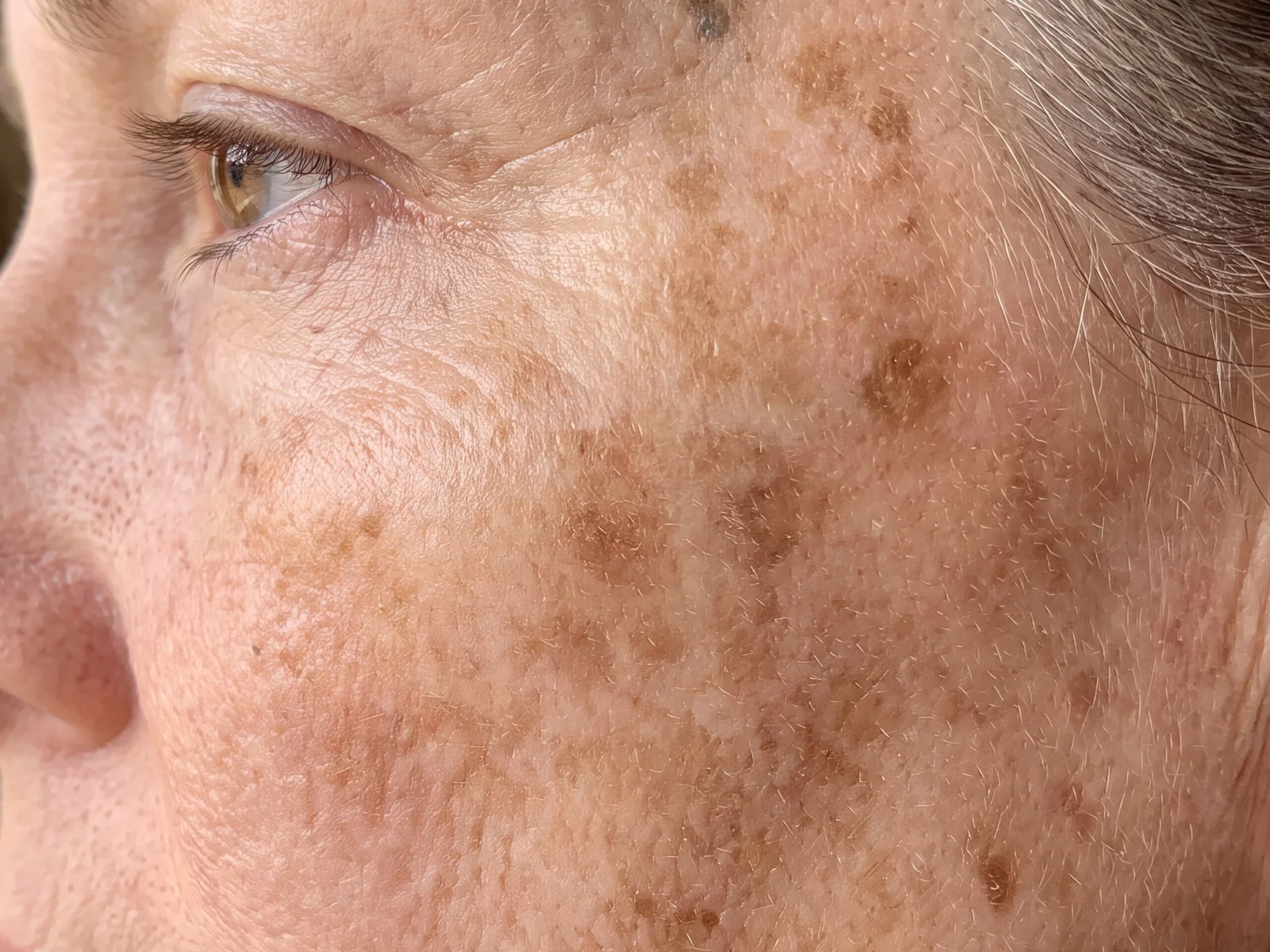
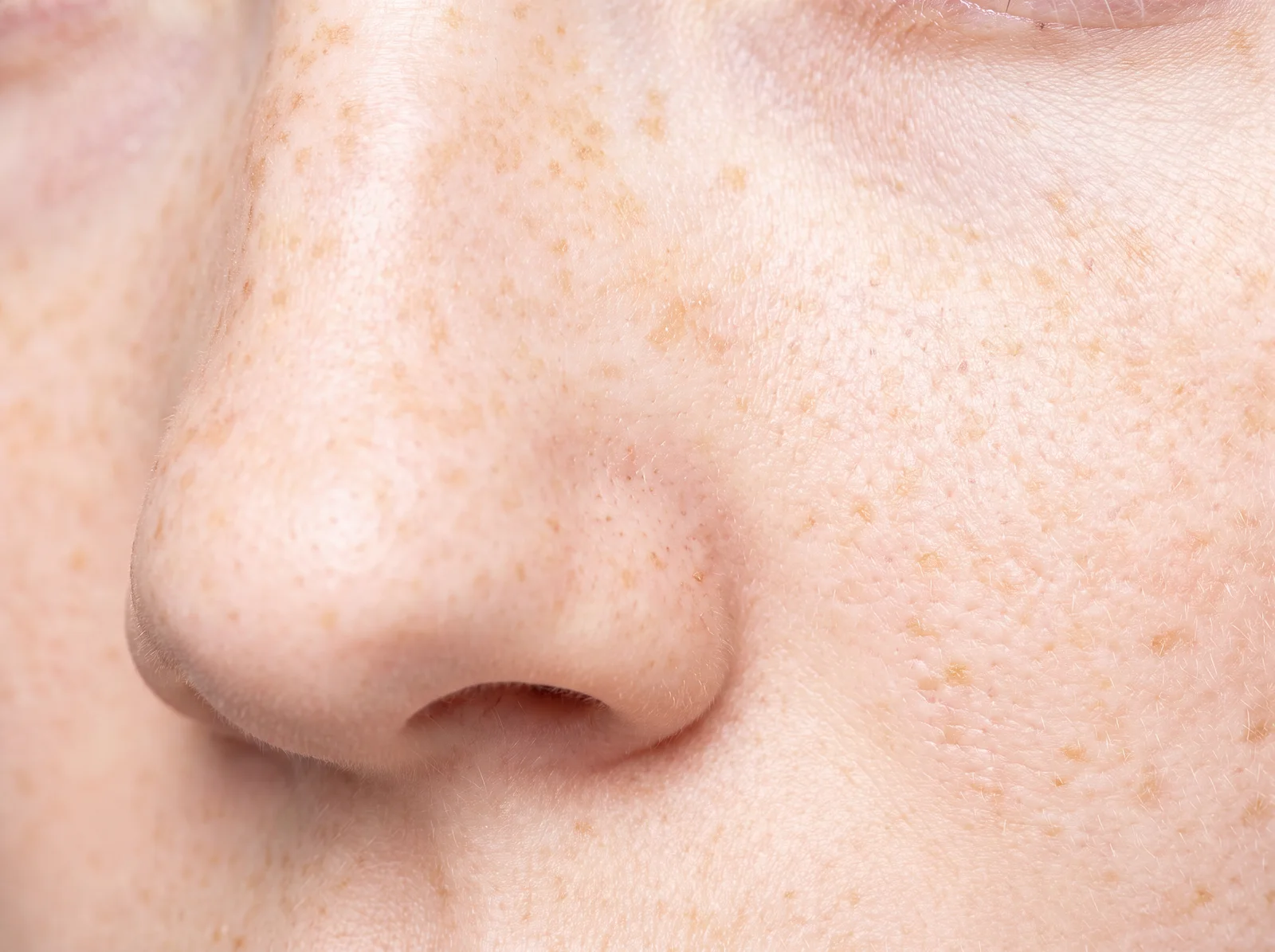
That is why sun spots and general sun damage are a satisfying thing to treat, and why laser pigmentation removal has the reputation it does. It earns that reputation on this type of pigment specifically. The pigment is defined, it is superficial, and it is exactly what the wavelength is tuned to find. This is also the pigment side of the resurfacing work: the same session that improves texture and fine lines addresses the brown of accumulated sun exposure.
The one non-negotiable that comes with it: none of this holds against continued ultraviolet exposure. Sun protection is not aftercare advice appended to the treatment. It is part of the treatment, because the same light that caused the spots will summon them back, and faster than any laser can clear them.
This is the part I most want you to read, because it is where good money is most often spent making things worse.
Melasma is not a stubborn version of a sun spot. It is a different disease: a chronic, relapsing disorder of pigment production, driven by hormones as much as by sun, in which the skin's pigment machinery is fundamentally overactive rather than simply marked (systematic review, PMID 33849384). That changes everything about how it should be approached.
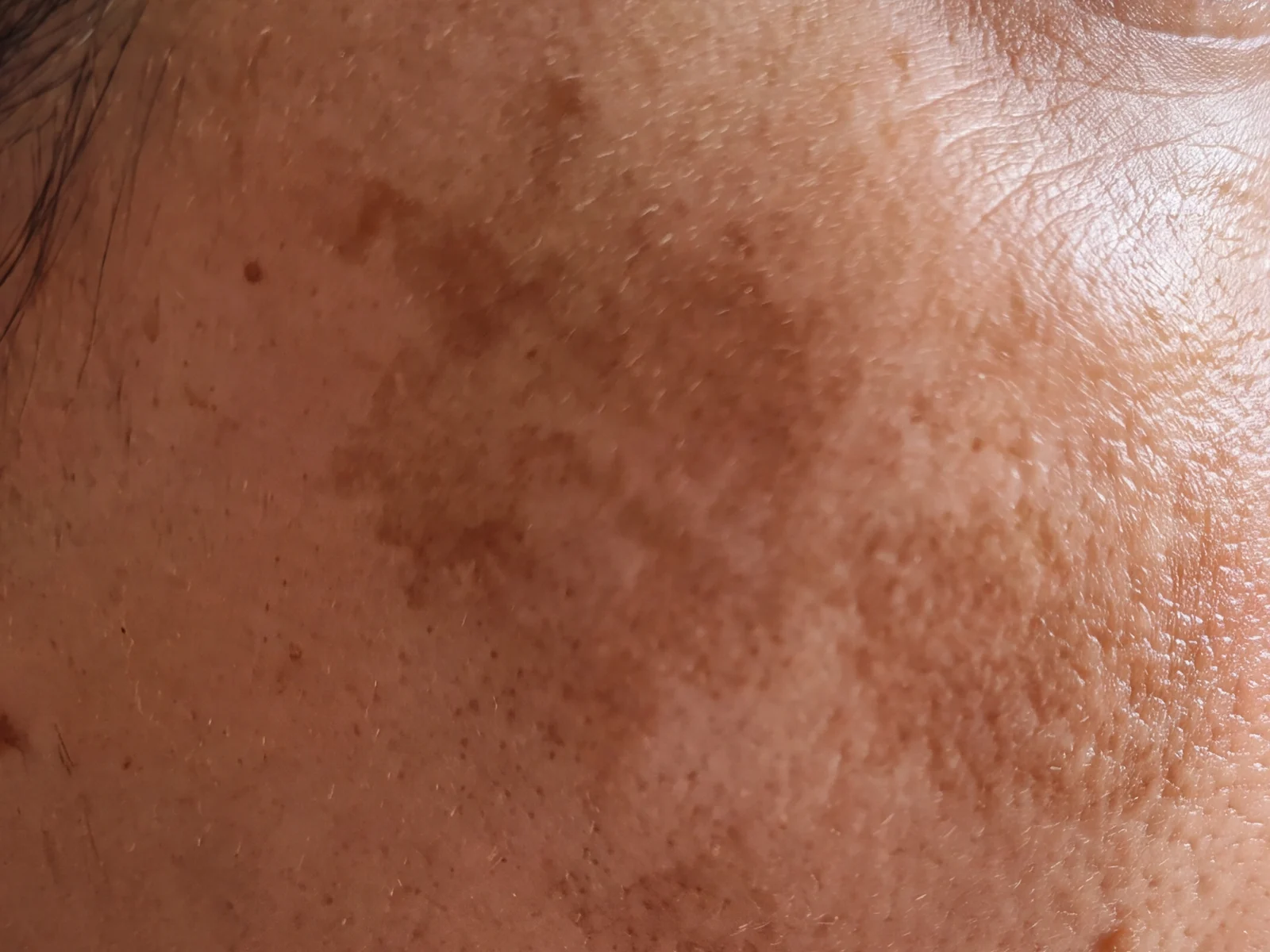
First-line treatment for melasma is not laser. It is topical, and the evidence for that is strong. A large evidence-based review found that triple-combination cream and hydroquinone remain the most effective and best-studied treatments, and that laser and light-based devices are equal or inferior to the topicals, while carrying a higher risk of adverse effects (evidence-based review, PMID 31802394). Read that twice, because it inverts what most people assume. For melasma, the cream is the better-evidenced treatment and the laser is the riskier one.
The risk is specific and it is real: heat and aggressive treatment can rebound melasma, making it darker than before. International consensus explicitly lists ablative and pro-inflammatory procedures, along with sun exposure, among the factors that increase the likelihood of relapse (consensus, PMID 39415312). Melasma-prone skin reads heat and injury as a reason to produce more pigment. So the very intensity that clears a sun spot can provoke a melasma patch.
And even when a laser does help melasma, it does not hold. In a controlled trial, both a laser combined with a topical agent and the topical alone improved melasma during treatment, then relapsed significantly once treatment stopped, and the laser made no difference to the rate of relapse (RCT, PMID 40776769). Melasma is a condition you manage over the long term, not a mark you remove.
So how melasma is actually treated well: rigorous daily sun protection as the foundation, topical pigment inhibitors first, and where an energy device is used at all, it is used at low intensity and with great caution, as a careful adjunct rather than the main event (systematic review, PMID 33849384). Anyone who proposes to blast melasma with an aggressive laser is more likely to set you back than to help you.
The most powerful laser I have will clear a sun spot and darken a melasma. That single fact is the whole of pigment treatment. Everything good depends on knowing which one is in front of me before I reach for it.
Dr Dana BeikiThe brown left behind after a spot, a scratch or a treatment is post-inflammatory hyperpigmentation, and the most important thing to know about it is that it is usually temporary. It is the skin over-producing melanin in response to inflammation, and as the inflammation resolves the pigment clears, over months rather than weeks.
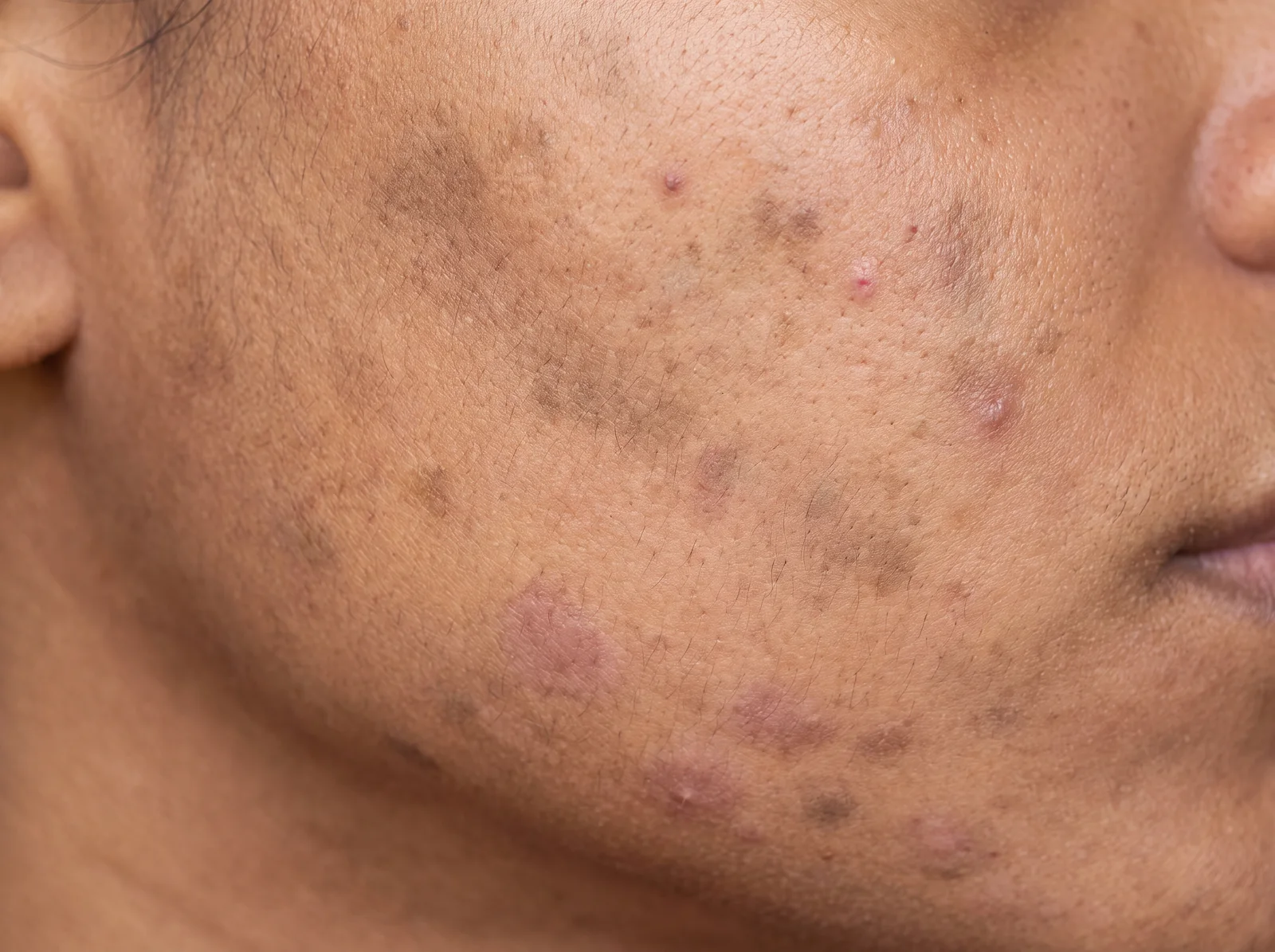
Because it fades on its own, the first move is patience and protection rather than an aggressive intervention that risks adding more inflammation, and therefore more pigment, to skin that is already prone to it. Sun protection speeds the fade and stops it deepening. Topical agents, retinoids in particular, have good evidence for accelerating it.
Where post-inflammatory marks follow acne specifically, the marks and any true scarring are separate problems that need separating, which is set out in the article on acne scarring. The brown fades; an indentation does not.
Almost every brown mark on a face is harmless. But there is one reason to assess pigment properly that outranks every cosmetic consideration in this article, and it is worth stating plainly.
An early melanoma can look like a sun spot. Lentigo maligna is a melanoma in situ that develops on sun-exposed skin, most often the face, in exactly the population who also have ordinary age spots. It mimics a solar lentigo, and it is distinguished by asymmetry, irregular borders and more than one colour within the same mark, rather than by being obviously alarming.
A benign sun spot is typically uniform in colour, flat, and evenly bordered. The features that should prompt a proper look are the familiar ones: asymmetry, edges that are notched, scalloped or poorly defined, more than one shade within a single mark and particularly any red, white or blue, a mark that is growing or changing, one that looks unlike all your others, or any that itches, bleeds or crusts.
Raised, rough, warty brown lesions are a different thing again. Those are usually seborrhoeic keratoses, which are benign, extremely common with age, and often mistaken for age spots. They sit proud of the skin rather than flat, which is the quickest way to tell them apart.
Here is the professional point that follows, and it is the reason the assessment matters more than the machine. A laser destroys the very thing a diagnosis depends on. Treating a pigmented lesion that has not been properly identified removes the evidence, and can delay a diagnosis that needed to be made early. So a mark we are not confident about does not get treated. It gets examined, and referred if there is any doubt. That is not caution for its own sake; it is the only responsible order to do this in.
If you have a mark that is changing, or one that simply looks different from the others, have it looked at before anyone treats it, whether that is with us, your GP or a dermatologist. Nothing in this article is a substitute for having a suspicious lesion examined.
| Your pigment | What it is | The lead treatment | Laser's role |
|---|---|---|---|
| Sun spots / age spots | Discrete brown marks from UV, superficial, on face and hands | Laser pigmentation removal, then sun protection | The best target it has |
| Freckles | Genetic, darken in sun | Sun protection; laser if wanted | Responds, but they return |
| General sun damage | Diffuse brown of years of exposure | Fotona resurfacing | Treated well alongside texture |
| Melasma | Chronic, hormonal, deeper, relapsing | Topicals + rigorous sun protection | Cautious adjunct at most; can worsen it |
| Post-inflammatory marks | Brown after injury or a spot | Time, sun protection, topicals | Rarely needed; risks more pigment |
| Any of the above, richer skin | Higher pigment reactivity | Gentler, slower, topical-led | Lower threshold for caution |
The table is the article in miniature. Two columns of pigment that look similar in the mirror, and a treatment plan that runs in opposite directions depending on which column yours is in.
This deserves stating plainly rather than nervously. The pigment concerns that most affect richer skin tones, melasma and post-inflammatory hyperpigmentation, are precisely the ones where laser carries the most risk, because the same responsive pigment system that produces them also over-responds to heat and injury with yet more pigment.
That is not a reason to avoid treatment. It is a reason to treat differently: topical-led where possible, energy devices chosen for wavelengths that target water rather than melanin and settings kept conservative, wider spacing, and a patch test first. Expert consensus is explicit that non-ablative and epidermis-sparing approaches, and wavelengths absorbed by water rather than melanin, are the safer route in richer skin tones (consensus algorithm, PMID 40847902). What is not acceptable is running the same aggressive settings on every skin and calling the resulting pigment bad luck.
If you have a richer skin tone and have been turned away from treatment altogether, or conversely offered an aggressive laser without hesitation, both are wrong. The correct answer is a considered plan, and that is what an assessment is for.
If you are unsure which kind of pigment you have, that is exactly what the first appointment establishes. A consultation at the clinic in Bath is free and commits you to nothing. We examine the pigment properly, identify its type and depth, and set out honestly what will move it, what needs a cream rather than a laser, and what is best left to fade with time and sun protection. You leave knowing what you are dealing with, which is more than most people are ever told.
Expect the discrete marks to lift and the tone to even, so your face reads as clear skin rather than a map of where the sun has been, and expect to reach for less foundation. Sun spots and sun damage respond well and often quickly. And expect, if what you have is melasma, a slower and more patient plan that keeps it quiet rather than a single dramatic clearance, because that is what actually holds.
Two things to carry with you. Sun protection is not optional in any of this, because ultraviolet is the one factor that undoes every result and provokes every type. And the honesty at the assessment is the treatment working, not the treatment being withheld: knowing your pigment is melasma, and being steered to the approach that suits it, is worth more than the most powerful laser aimed at the wrong target.
What we are doing is precise. Read the pigment before treating it. Match energy to sun-driven marks that will clear, and match patience and topicals to the pigment that heat would only deepen. Protect every result from the light that caused the problem. Pigment is not one thing, and the skill is not the strength of the laser. It is knowing, before you use it, which pigment is in front of you.
However you begin, it starts with a conversation.
Book a consultation with Dr Beiki, or start free with an online assessment in your own time.
Rated 5.0 on Google · 30 reviews
Goodlight Wellness Center · Bath