One moment
Preparing the page.
Loading content…One moment
Preparing the page.
Loading content…PRP treatment for hair works best sequenced with a laser pass rather than given on its own. A thinning follicle is not a dead one, which is why the earlier you treat it the more there is to keep. Fotona HAIRestart is a four-part protocol built on that: a Fotona laser pass to prime the scalp, platelet-rich plasma to feed the follicle, polynucleotides to rebuild the tissue around it, and photobiomodulation to settle and support it. It is built as a combination because the evidence in androgenetic alopecia consistently favours combining treatments over relying on one. Shedding usually quietens within about six weeks, density and thickness build over three to six months, and there is no downtime at all.

You notice it in a particular light, and usually before anyone else does. The parting looks wider under the bathroom spotlights. There is more scalp in the photograph than you expected. You start doing a quiet arithmetic every morning, and adjusting how you dry it.
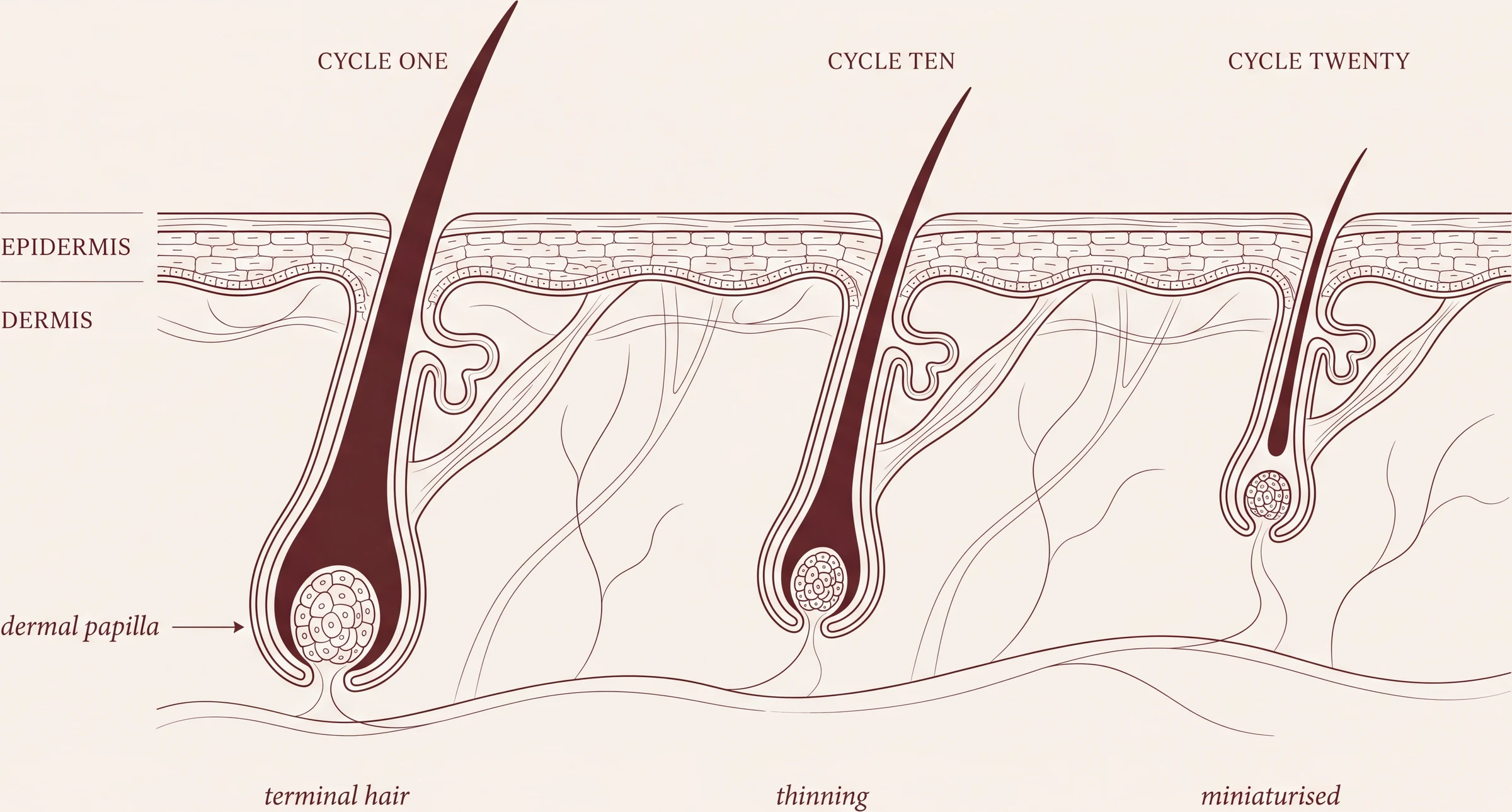
This article is about Fotona HAIRestart, the four-part protocol we use for thinning hair, and the biology it is built on. The useful thing to understand early is that a thinning follicle is not a dead one. Androgenetic alopecia works by miniaturisation: with each growth cycle the follicle shrinks a little, the hair it makes comes back finer and shorter, and eventually the cycle stalls. That is a slow process with a long window, and it is why intervening matters. There is something still there to work with, and the earlier you work with it, the more of it there is.
This is worth understanding properly, because every treatment below is aimed at one step of it, and knowing which step tells you what each one can and cannot do.
Hair does not grow continuously. Each follicle cycles: anagen, the growing phase, which on the scalp runs for years; catagen, a brief regression; and telogen, a resting phase after which the hair is shed and the cycle restarts. At any moment most of your follicles are growing and a minority are resting, which is why ordinary daily shedding is normal and not a sign of anything.
At the base of each follicle sits the dermal papilla, a small cluster of specialised cells that effectively instructs the follicle how large a hair to build. Its cell population is not fixed. Through each cycle, cells move between the papilla and the surrounding dermal sheath, and the size of that population sets the calibre of the hair produced. In androgenetic alopecia there is a net loss of dermal papilla cells with every cycle, so each successive hair is built to a slightly smaller specification. That is miniaturisation, and it explains the pattern precisely: not hair falling out in clumps, but hair returning progressively finer until it is barely there (review of hair growth mechanisms, PMID 35156098). That source is a narrative review rather than trial evidence, so I give it to you as the current working model rather than as settled fact.
What drives that loss is dihydrotestosterone, converted from testosterone in the scalp, acting on susceptible follicles. Susceptibility is inherited, which is why this runs in families and why the pattern is so reproducible: temples, crown and mid-front in men, and in women the diffuse central thinning with a preserved frontal hairline that is called female pattern hair loss (review, PMID 39086171). It is also why the established drugs work where they do. Finasteride inhibits the enzyme that makes dihydrotestosterone, lowering it substantially; minoxidil prolongs the growing phase and increases follicle diameter (systematic review, PMID 32295047). One addresses the driver, the other the cycle.
There is a blood-supply dimension too, and I want to grade it honestly rather than overstate it. The proposal is that the areas of scalp worst affected by miniaturisation sit in a lower-oxygen environment, and that blood flow may therefore be a determinant of follicular health. That is the stated rationale behind treatments aimed at scalp perfusion, and it is presented in the literature as a hypothesis rather than as a measured finding (review, PMID 33562846). It matters for what follows because it points at a target the drugs do not address at all.
Before anything else, it is worth working out which of two quite different things is happening, because they have different causes, different timescales and different answers.
Thinning is androgenetic alopecia, the miniaturisation described above. It is gradual, it follows a pattern, and the hair comes back finer rather than not at all.
Shedding is telogen effluvium, and it is a different event entirely. Normally about 85 per cent of scalp follicles are growing and 15 per cent resting. Under significant metabolic stress that balance is disrupted and a large share of growing hairs is pushed prematurely into the resting phase, so they are all shed together a few months later. That is why the shed arrives long after the event that caused it, and why people so often cannot connect the two (review of telogen effluvium, PMID 28613598).
The recognised triggers are worth knowing, because most are correctable and several are common: childbirth and the fall in oestrogen that follows it, a febrile illness or serious infection, major surgery, thyroid dysfunction, iron deficiency, stopping an oestrogen-containing medication, low protein intake, and crash dieting (PMID 28613598).
That last one now matters more than it used to. Telogen effluvium has been documented after vigorous weight-reduction programmes, with the proposed mechanism being that severe caloric restriction leaves the hair matrix without the energy supply it needs to keep growing (review, PMID 30547302). Rapid weight loss on a GLP-1 medication produces exactly that pattern, and it is now one of the more common reasons people arrive convinced they are going bald. I want to be precise about what is and is not established here: the documented mechanism is rapid weight loss and reduced intake, not a direct effect of the drug on the follicle. The practical consequence is the same either way, and so is the reassurance, because this kind of shedding usually recovers once intake and weight stabilise.
Vitamin D deserves a mention too, since it is the deficiency most consistently linked to hair problems. A systematic review found associations between vitamin D deficiency and non-scarring alopecias including female pattern hair loss and telogen effluvium (systematic review, PMID 39416654). Association is not causation, but it is a reason to measure it rather than guess.
The reason this section comes before the treatment is simple. If you are shedding rather than thinning, the answer may be a blood test and some patience rather than a protocol, and you deserve to know that before you spend anything.
Start with the single most consistent finding in this field, because it shapes everything else.
A systematic review of 141 studies on managing androgenetic alopecia concluded that treatments across every category promote hair growth, over the counter, prescription and procedural, and that the superior approach is multifaceted and individualised rather than any one treatment used alone (systematic review, PMID 38852607). Platelet-rich plasma, fractional lasers and hair transplantation are all named among the procedural options that work.
That is the logic of the protocol we use. Not one thing done hopefully, but several mechanisms matched to one scalp, because the evidence says combinations outperform monotherapy in this condition specifically.
HAIRestart is a Fotona laser pass across the scalp, platelet-rich plasma, polynucleotides, and photobiomodulation added alongside. They do genuinely different jobs, and their evidence is not equally strong. You should know which is which, because that is the difference between a plan and a package.
Platelet-rich plasma carries most of the evidence. We take a small sample of your blood, spin it to concentrate the platelets, and deliver that concentrate into the scalp. Platelets carry growth factors, and putting them where the follicle is appears to support its cycle directly.
Look at where that lands against the biology above. Platelet concentrates promote proliferation of the dermal papilla cells, the population whose steady loss causes miniaturisation in the first place; they increase vascularisation around the follicle, addressing the poor perfusion measured in balding scalp; and they appear to accelerate the transition from the resting phase back into growth (review of platelet concentrates, PMID 39086171). Three mechanisms, each aimed at a different step of the process that is shrinking your hair. That is a considerably better rationale than "growth factors are good for you," and it is why this component carries the protocol.
The clinical record matches. A meta-analysis of 11 studies in 262 patients found significantly more hairs per square centimetre after PRP than in controls, and a significantly higher terminal hair density, though its authors ask that the result be read with caution because the source studies were small and varied (meta-analysis, 262 patients, PMID 31187167). Across the wider review literature, topical minoxidil combined with intradermal PRP is reported as more effective than minoxidil alone (review of platelet concentrates, PMID 39086171). If you want the component with the most published support, this is it.
Polynucleotides address calibre rather than count. These are purified DNA fragments that signal the fibroblasts around the follicle to rebuild the tissue environment it sits in. They improve hair thickness and density, and combining PRP with polynucleotides produces greater thickness gains than either one alone (review, PMID 39086171). That distinction matters more than it sounds. Fullness is not only about how many hairs you have; it is about how substantial each one is. A scalp that has thinned in calibre rather than in number often responds better to this than to anything else.
The Fotona laser opens the scalp for everything that follows. Fractional lasers sit among the procedural treatments the systematic review above found to promote hair growth (PMID 38852607). The mechanism is the same precision described in the resurfacing article, applied at a gentler setting: controlled stimulation raises local blood flow and cellular activity, and the microchannels it creates are a route into the scalp for what comes next. Sequence matters here. The laser pass comes first because it primes the tissue, so the PRP and polynucleotides arrive somewhere ready to use them.
Photobiomodulation is added alongside, for two reasons. This is what is usually meant by red light therapy for hair loss. Low-level red and near-infrared light is absorbed by the mitochondria in your cells, raising cellular energy production, lowering inflammatory signalling and increasing local blood flow. On the scalp that serves two purposes at once: it settles the treated area after the injections, which is the role it plays across the rest of our work, and low-level light applied to the scalp is a recognised approach to hair growth in its own right.
Hair loss is rarely just hair loss. Before I treat a scalp I want to know about your iron, your thyroid, your stress and your sleep. The protocol works better on a body that has been listened to first.
Dr Dana BeikiThere is a reason the first appointment here involves questions that sound unrelated to your hair.
Androgenetic alopecia is the most common cause of thinning, but it is not the only one, and it frequently travels with others. Iron deficiency, thyroid dysfunction, a period of acute stress, a crash in nutrition, post-partum shedding and certain medications all cause hair loss, and several of them are correctable. Treating the scalp while an underlying driver runs unchecked is how people spend money on a course and see very little.
So we look at that first, and blood tests are often part of it. If the cause turns out to be something correctable, that is a better outcome than any protocol, and it is worth finding before you commit to a course rather than after.
Hair keeps its own clock, and no treatment overrides it.
Shedding usually settles first, often within about six weeks. Visible change in density comes later, generally between three and six months, because that is how long the follicle takes to move through its cycle and produce a hair you can actually see. Anyone promising a visible difference in weeks is describing a timescale that biology does not offer.
This is also maintenance rather than cure. Androgenetic alopecia is progressive and driven by hormones and genetics, neither of which the treatment changes. What the protocol does is keep the follicles you still have in the game, working better and for longer. Sessions continue at intervals, and the plan is reviewed as your scalp responds.
| Your situation | What tends to suit it |
|---|---|
| Early thinning, follicles still active | The full combination, started now while there is most to preserve |
| Thinned in calibre, hair gone fine rather than absent | Polynucleotides weighted more heavily, for thickness |
| Wanting the best-evidenced single component | PRP, which has the strongest trial record here |
| Shedding after illness, stress or childbirth | Investigation first. This often resolves, and may need no procedure at all |
| Suspected deficiency or thyroid involvement | Bloods before anything else, and correct what is correctable |
| Areas where the follicle is gone entirely | Hair transplant surgery, which moves living follicles. It does what no injectable can |
Worth saying plainly, because it affects whether you should be here at all.
A hair transplant moves living follicles into thinned areas and produces a lasting structural change that no injectable protocol matches. Where an area has genuinely lost its follicles, that is the treatment that addresses it, and I will tell you so rather than sell you a course that cannot reach it.
What this protocol is for is the hair you still have: the miniaturising follicles that are stalling but alive. Those two things are complementary rather than competing, and plenty of people do best having preserved what they have before deciding whether they need anything more.
If you are unsure which of those describes your scalp, that is exactly what the first appointment establishes. A consultation at the clinic in Bath is free and commits you to nothing. We assess the pattern and density, discuss what has been happening and when it started, and arrange bloods where they are warranted. If the answer is that you need investigation rather than treatment, or surgery rather than us, you will hear that.
Expect shedding to quieten first, then density and thickness to build slowly over three to six months, and expect to feel less preoccupied by it long before the mirror fully agrees. Most people describe the relief as the arithmetic stopping: they stop counting, stop checking the parting in every reflection, stop planning around it.
Two things to hold in view. The follicle has to be alive for any of this to reach it, which is why starting earlier gives you more to work with. And this is maintenance of a progressive condition, not a cure for it.
What we are doing is specific. Concentrate your own platelet growth factors and put them where the follicle can use them. Signal the surrounding tissue to rebuild the environment it depends on. Stimulate the scalp so that the whole thing lands on tissue that is primed for it. Then measure, at intervals, whether your scalp is responding, and adjust what we are doing on the evidence of your own follicles rather than an average.
However you begin, it starts with a conversation.
Book a consultation with Dr Beiki, or start free with an online assessment in your own time.
Rated 5.0 on Google · 30 reviews
Goodlight Wellness Center · Bath