One moment
Preparing the page.
Loading content…One moment
Preparing the page.
Loading content…Profhilo is a hyaluronic acid skin booster: it supplies hydration and scaffold across the skin. Polynucleotides are a signalling injectable that may prompt the fibroblast to rebuild. One is the material, the other is the instruction. They work differently, and in practice they are often used together.


These two names tend to reach you as rivals. One friend books Profhilo and comes back talking about her skin feeling plumper within the week. Another has been going for polynucleotide sessions and tells you the salmon DNA one is the future, that it works on a deeper level, that hyaluronic acid is just water and hers actually rebuilds. You have seen the same split online: a hydration camp and a repair camp, each faintly suggesting the other has picked the lesser treatment. So you arrive expecting to have to choose a side, and to feel slightly behind whichever way you choose.
The argument is real, but it is aimed at the wrong question. Both friends are describing something true. What neither has been told is that the two treatments are answering different biological briefs, and that the science has a clean word for each. Once you have those two words, the rivalry stops being a contest and becomes a choice about what your own skin is short of.
Aesthetic medicine already separates these. Bio-revitalisation directly supplies material to the skin. Bio-stimulation drives the anabolic activity of the fibroblast, the cell that manufactures your dermis. One hands the skin a component. The other asks the cell to make its own. Profhilo sits closer to the first brief, polynucleotides to the second, and almost everything that follows comes from that.
Profhilo is not an ordinary hyaluronic acid. It is a hybrid cooperative complex: high-molecular-weight hyaluronan (around 1100 to 1400 kDa) and low-molecular-weight hyaluronan (around 80 to 100 kDa) thermally bonded together by the NAHYCO process, with no chemical cross-linking (PMID 37623069). That pairing is the whole design. The long chains are the water-binding engine, holding many times their weight in water to restore turgor across the tissue; the short chains would normally be cleared within a day, but the thermal bond lets them persist long enough to stay biologically active. Its very high flowability is why a single bolus spreads through the plane rather than sitting as a lump. In people, this is the part that is actually proven: a systematic review (PMID 41920062) finds Profhilo improves hydration, elasticity and overall skin quality. The collagen and elastin response is established in cell culture, and what is measured in people is the hydration, elasticity and firmness. I will tell you which is which rather than blur them together.
A polynucleotide works from the other end. These are long fragments of purified DNA, taken from salmon or trout and cleaned of the proteins that would provoke a reaction. The name misleads almost everyone: injected into the dermis they are not read as genetic instructions, and they do not repair your DNA. What they do is more useful. They hold water in an iso-osmotic gel, they scavenge the reactive oxygen species that accumulate with sun and age, and against that calmer, better-hydrated background they signal the fibroblast to raise its output of glycosaminoglycans, structural proteins and fibrils (consensus report, PMID 32799391; systematic review, PMID 39645667). That mechanism is drawn from laboratory and consensus work; it describes how the molecule is understood to act, not an effect measured pathway by pathway in people. The honest headline is the plainer one: it does not deliver much material, it changes the cell's behaviour.
One supplies the skin its material, the other changes what the cell does with it. Ask which job your skin needs first and the rivalry you were sold quietly dissolves.
Dr Dana BeikiThe short answer, by skin. If yours is mainly dry, lax and under-supported, start with Profhilo and restore the material. If it is thin, crepey or oxidatively tired, start with polynucleotides and drive the cell. And when the plan is both, the mechanism argues for polynucleotides first, to prime the tissue, then Profhilo to supply it.
Side by side, the two briefs look like this:
| Profhilo | Polynucleotides | |
|---|---|---|
| What it is | A hybrid hyaluronic acid complex of high- and low-molecular-weight HA, thermally bonded, no cross-linking | Purified DNA fragments from salmon or trout, cleaned of reactive proteins |
| What it does | Bio-revitalisation: supplies the skin its material (water, turgor and scaffold) | Bio-stimulation: signals the fibroblast to raise its own output |
| Best for | Dry, lax, under-supported skin; hydration across a wider area | Thin, crepey, tired or oxidatively stressed skin; quality and texture |
| Onset | Immediate: hydration and early plumpness from day one | Gradual: a cell-led response building over the weeks after each session |
| Course & upkeep | Usually 2 sessions, 4 weeks apart; topped up roughly every 6 months | Usually 3 sessions, around 4 weeks apart; topped up roughly every 6 months |
| Fish allergy | Non-animal HA, so unaffected | Fish-derived, so a genuine fish allergy rules it out |
| Evidence in people | Improves hydration, elasticity and skin quality (PMID 41920062) | Comparable to HA, edging skin-quality measures in a split-face trial (PMID 32248707) |
Here the evidence is far calmer than the argument around it, and it points somewhere more interesting than a winner.
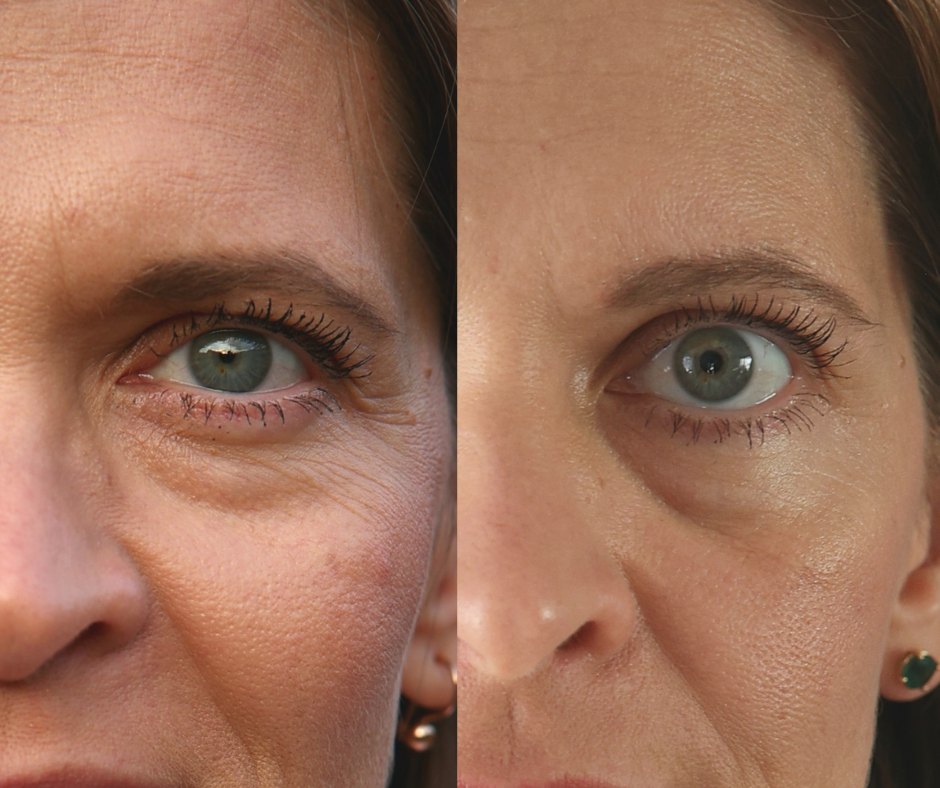
In a split-face randomised controlled trial (PMID 32248707) of 27 people, comparing polynucleotide against a plain non-crosslinked hyaluronic acid around the eye, the two were comparable on the headline scores and on dermal density, with the polynucleotide side improving more on elasticity, hydration, surface roughness and pore volume. Read that carefully before you lean on it. It is 27 people, around one feature, and the comparator was a hydrating hyaluronic acid rather than Profhilo. No trial has compared Profhilo directly against a polynucleotide in people. So the honest reading is not that one beats the other. It is that the question has never been asked in the form patients ask it, and what evidence exists suggests they land in the same place by different roads. The under-eye use has its own piece: polynucleotides for the under-eyes.
That is what the mechanism predicts. Both treatments are ultimately working on the same two things, the fibroblast and the matrix around it. Hyaluronic acid restores the hydrated, well-supported environment the cell needs to function; polynucleotides push the cell's own production while clearing the oxidative load. Converging on one target from two directions is exactly why a head-to-head measuring skin quality finds them close. The rivalry was always louder than the biology.
The mechanism sets the timing, which is why your two friends described different experiences honestly. Profhilo carries an immediate component: the high-molecular-weight chains bind water on day one, so the hydrated, better-supported surface, the early plumpness, is real and quick. Polynucleotides are slower by design, because a cell-led response builds over the weeks after each session rather than arriving on the day. Neither is a single-visit treatment. Both are given as a short course and then maintained: Profhilo usually two sessions four weeks apart, polynucleotides usually a course of three around four weeks apart, with both topped up roughly every six months. Because each works with your own tissue, results build and then fade gradually rather than switching off, and the exact interval is judged at review rather than fixed in advance.
Profhilo suits you when the skin itself feels dry, lax and under-supported and you want hydration and scaffold across a wider area. It is a sound first move when the surface is the complaint.
Polynucleotides suit you when the aim is to drive your own fibroblasts, on thin, crepey, tired or oxidatively stressed skin where quality, elasticity and texture are what you are after over a course.
Neither suits you if what bothers you is volume loss or significant skin laxity that wants lifting. Both improve the quality and support of the skin you have; they do not fill a hollow or reposition tissue, and it would be dishonest to pretend an injectable competes with surgery for a true sag. That is the one thing to hold clearly, then set aside. And if the issue is a softening lower face and jaw specifically, the firmer Profhilo Structura is the member of the family built to support it.
Recognise your skin in one column more than the other? That instinct is usually a good start, but which to lead with, and whether the plan is one or both, is exactly the reading a consultation exists to make.
Both are injected, so you feel needle entry, with discomfort that is generally brief and manageable, and comfort measures agreed at consultation. You may see small injection points and short-lived swelling or bruising, and most people return to normal activities the same day. One practical difference decides candidacy before anything else: polynucleotides are fish-derived, so a genuine fish allergy rules them out while leaving Profhilo, a non-animal hyaluronic acid, perfectly available. Beyond that, the safety that matters is the assessment behind the injection and the hand giving it. The current per-area and course prices sit on the Profhilo and polynucleotides treatment pages, and the consultation itself is free.
If you want a single line: choose Profhilo when the skin needs its material restored, choose polynucleotides when the cell needs stimulating, and expect a serious plan to often use both, in that order, for a reason. Which split is right is a reading of your own skin, and that reading is what a consultation is.
They were never rivals to me. They are two mechanisms, and the work that interests me is reading which one your skin is short of, then reaching for it with precision.
However you begin, it starts with a conversation.
Book a consultation with Dr Beiki, or start free with an online assessment in your own time.
Rated 5.0 on Google · 30 reviews
Goodlight Wellness Center · Bath