One moment
Preparing the page.
Loading content…One moment
Preparing the page.
Loading content…A realistic polynucleotide before and after shows a change in skin quality, not shape: crepey texture looking smoother, fine lines and crinkling softened, the surface more hydrated and even. It does not add volume, lift laxity or clear pigment. The change builds over the weeks after a course of three sessions, with the fuller result about a month after the final one, and a 2025 systematic review confirms the improvements to skin texture, elasticity and hydration.

"Polynucleotides before and after" is one of the most searched things about this treatment, and for a sensible reason: you want to see that it works before you spend on it. Fair. But a before-and-after is also the most manipulated image in aesthetics, so the useful skill is not finding one, it is reading it. Here are two of mine, and an honest account of what they do and do not show.
What a polynucleotide before-and-after actually shows, when it is honest, is a change in the quality of the skin: crepey texture looking smoother, fine crinkling softened, the surface more hydrated and even. Not a new face, not filled lines or a lifted jaw. The self you are looking for in the "after" is your own skin, a few years back in condition.
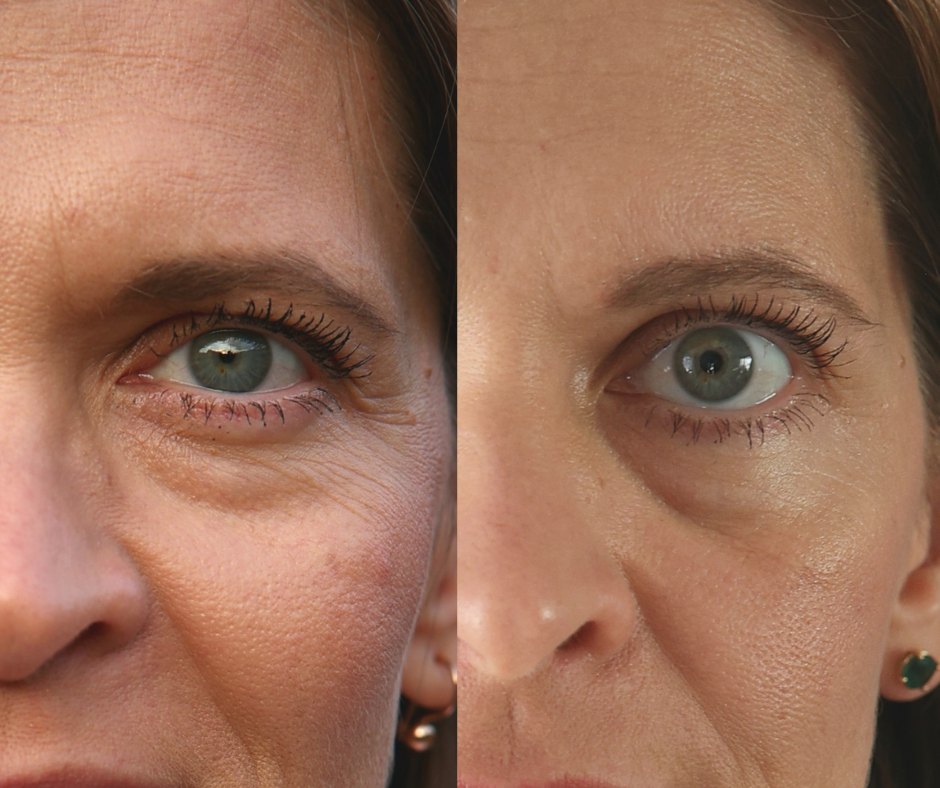
The polynucleotides before-and-after at the top of this page is the first: the under-eye, before on the left and after on the right, over a short course. Look at the skin itself rather than the whole eye. The fine crepey crinkling under the lower lid has softened, and the surface reads as smoother and more even. Now look at what has not changed. The slight fullness under the eye is still there, because that is volume and shadow, and polynucleotides do not treat volume. If your real concern is an eye bag or a hollow, this is not the treatment that fixes it, and I would tell you so at the consultation rather than after.
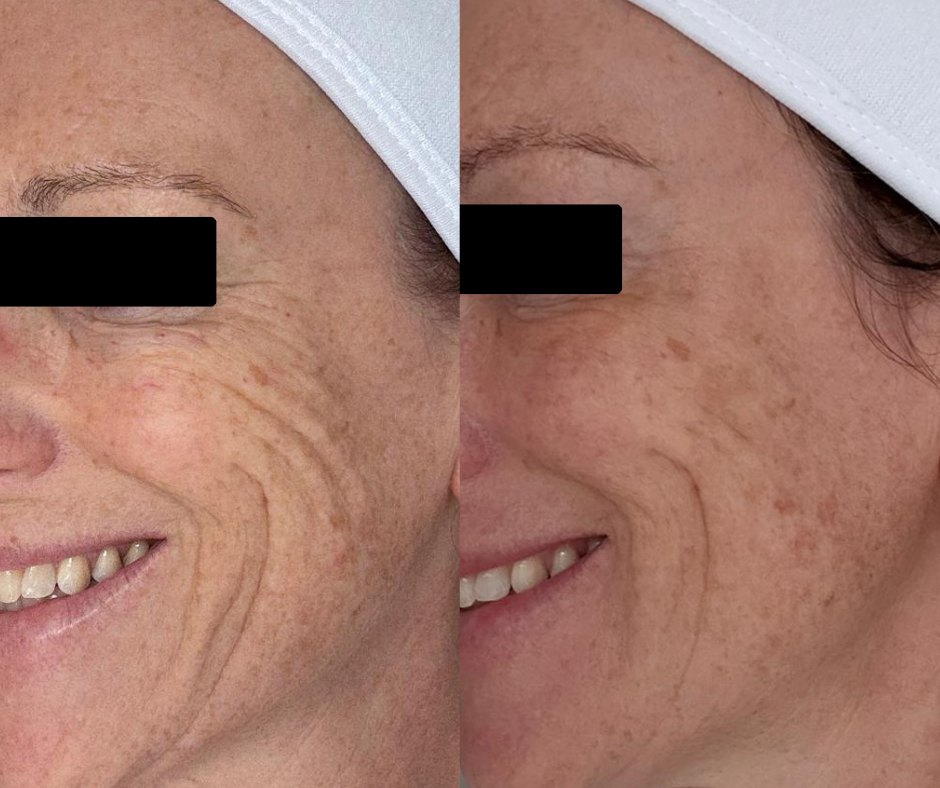
The second is skin quality across the lower face. The fine, crepey texture on the cheek in the "before" is noticeably smoother and firmer in the "after", the skin looks better hydrated, and the dynamic lines, the ones that deepen as the face moves, sit less deeply. Even the freckling reads as a little less prominent, though that needs an honest word: polynucleotides are not a pigment treatment and will not remove a freckle or a sun spot. What happens is subtler, and worth explaining, which is the next section.
A polynucleotide before-and-after should show a difference in skin quality and nothing it cannot deliver. Expect smoother texture, softened fine lines and crepiness, better hydration, a more even and rested surface. Do not expect added volume, filled deep folds, lifted laxity or cleared pigment. When a before-and-after appears to show those, either something else was done at the same time, or the photograph is doing the work the treatment did not.
That is consistent with the evidence. Pooled across nine studies covering 219 patients, polynucleotides improve skin texture, elasticity and hydration (2025 systematic review, PMID 39645667). Measured, and specific to the quality of the skin. Those nine studies are small and the reviewers grade them low to moderate quality, which is the ordinary state of the evidence across aesthetic medicine rather than something particular to polynucleotides.
The results above are not sitting on top of the skin. They come from what the polynucleotides prompt the skin to do. Injected into the dermis, they signal fibroblasts, the cells that build and maintain the skin's support structure, to work harder, hold water in the tissue, and scavenge the free radicals that drive ageing (expert consensus, PMID 32799391). Better-supported, better-hydrated skin is firmer and smoother, which is why the texture improves and why the fine and dynamic lines sit less deeply. The same calming of inflammation and oxidative stress leaves the surface more even, which is part of why existing pigment can read as softer even though it has not been removed. Some studies do report modest gains in skin tone (consensus report, PMID 32799391), but I treat tone as a welcome secondary effect, not a reason to choose the treatment. Most of this detail comes from laboratory and animal work; the human trials measure the result, texture, elasticity and hydration, not the pathway.
One honest caveat, because you will see it offered this way. Polynucleotides are sometimes sold as an acne treatment. They do calm inflammation, which is real, but reducing inflammation is not the same as treating acne, and I would not have you rely on them for it. Active acne needs treatment aimed at the acne itself.
This is the question most people actually have, so here is the honest answer: not on the day. Polynucleotides work by prompting your own skin over its repair cycle, so the change builds over the weeks after each session rather than appearing at once. A course is three sessions of Nucleofill about four weeks apart, and most people see the fuller result a month or so after the final session, not before. The trials followed the improvement for roughly three to six months, and because it is improving living skin rather than sitting in it, a single session about twice a year keeps it there.
| When | What changes |
|---|---|
| Treatment day | Nothing yet; the change builds over your skin's repair cycle rather than appearing at once |
| The weeks after each session | Texture, fine crepiness and hydration gradually improve |
| The course | Three sessions of Nucleofill, about four weeks apart |
| A month or so after the final session | Most people see the fuller result |
| Roughly three to six months | The window the trials followed the improvement across |
| About twice a year | A single maintenance session keeps it there |
So if someone shows you a dramatic "after" taken the same week as the "before", be sceptical. That is not how this treatment behaves, and it is usually a sign that either the lighting or another treatment is doing the talking.
The thing I tell every patient is worth more than any before-and-after: you will not catch the change in the mirror. A few weeks on, other people will decide you look well and not be able to say why. That, not a vanished line, is the result worth having.
Dr Dana BeikiThe most convincing results come from the skin polynucleotides are built for: skin that has lost quality more than shape, crepey under the eyes, on the cheeks, the neck or the backs of the hands, in someone whose concern is texture and condition rather than volume or a defined line. If that is your skin, a realistic "after" is a genuinely good one.
If you are not sure whether your concern is texture or something polynucleotides cannot change, that is exactly what a consultation is for: an honest read of your skin before you spend anything.
If your concern is a hollow, a fold or pigment, the honest answer is a different treatment. The complete polynucleotides guide explains exactly where that line falls; for the eyes specifically, polynucleotides for the under-eyes goes deeper; and the polynucleotides treatment page is where to book.
A before-and-after is only worth something if you can trust how it was made and what it is really showing, and no photograph of someone else is a promise about your skin. Mine show what polynucleotides do: better skin, honestly photographed. If that is the result you are after, it is one I am confident putting my name to.
However you begin, it starts with a conversation.
Book a consultation with Dr Beiki, or start free with an online assessment in your own time.
Rated 5.0 on Google · 30 reviews
Goodlight Wellness Center · Bath