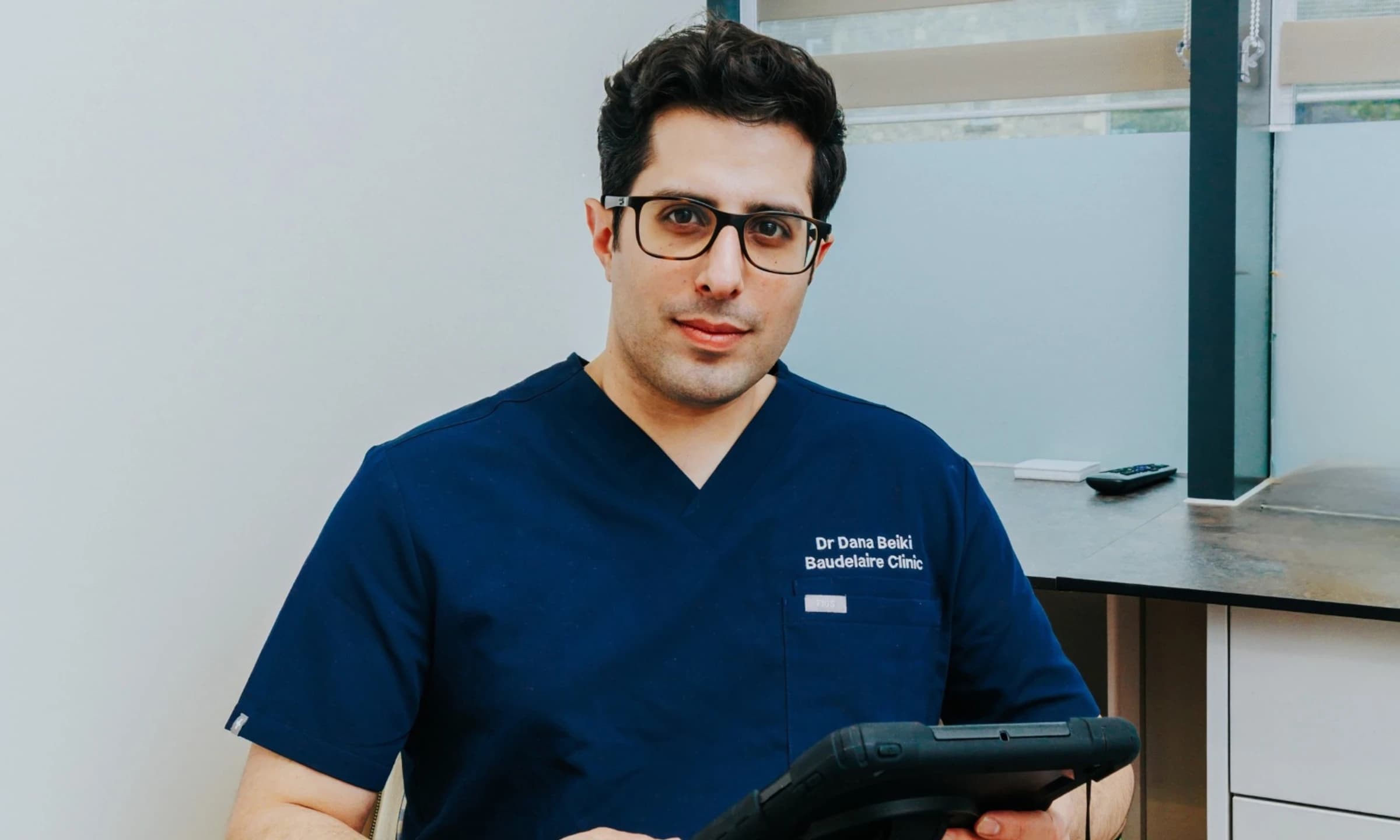
The appointment ends, the door closes, and you are on your own until someone decides it is time to sell you something else. That is how most of aesthetic medicine works, and it was the part I could never make peace with. Le Cabinet is what I built instead: a private place inside our practice where your face is read as one thing, your plan opens at the pace your skin actually changes, and I stay your doctor between the appointments, not only during them.
I trained as a pharmacist and a research scientist before I ever treated a face. That order matters, because it means I came to this work through the evidence rather than the marketing, and the marketing is most of what is wrong with it. So this is not a brochure for a piece of software. It is an explanation of why a clinic that takes the science seriously ended up building itself a memory.
What I could not accept
Most clinics are built around the single visit. You arrive with one concern, you are treated for it, you leave, and the relationship pauses until something else goes wrong or an offer lands in your inbox. Nobody is holding the whole picture. Nobody is watching how your skin actually behaves across the months when its behaviour is the only thing that tells us what to do next. I found that strange as a scientist, and worse as a patient, because skin does not work in single visits. It changes slowly, and it changes whether or not anyone is paying attention.
I did not want to run a place you visit. I wanted to run a place that keeps your face in mind.
Why the clinic existsA face is not a list of problems
There is a comfortable idea, repeated for centuries, that beauty is a fixed number: the golden ratio, 1.618, the same proportion said to run through the Parthenon and through a beautiful face. It is a lovely idea. It is also, when you actually measure faces, not true. A 2024 systematic review pooled the studies and found that attractive faces do not follow the golden proportion. The numbers simply do not hold (systematic review, PMID 35738927).
What the research keeps finding instead is subtler and more useful. Beauty is not one measurement. It is harmony, the relationship between the parts of a face, and it is largely particular to you. This is why a consultation that treats one line at a time is answering the wrong question. If I relax your frown and ignore that your cheeks have flattened and your jaw has softened, I have corrected a detail and missed the sentence. So the reading has to be of the whole face, its harmony, before anything at all is proposed.
Baudelaire’s idea of beauty
The clinic is named for the poet Charles Baudelaire, and not as decoration. He spent much of his life on one question, what beauty actually is, and arrived at an answer I have never been able to improve on. In his essay The Painter of Modern Life, he wrote that beauty is always made of two elements. One is eternal and shared, the part every beautiful face has ever had in common. The other is particular and passing: the age you are, the features you were born with, the life written into your expression. Both halves are essential. A face with only the eternal part is a mannequin; a face with only the particular is a passing moment. Real beauty is both at once.
Most aesthetic medicine treats only the first half. It keeps a single template in mind, the same smoothed, filled, symmetrical face, and moves everyone towards it, erasing the particular as though it were the fault. You have seen the result: rooms of people who look treated, and faintly like one another. I think that is a misreading of the poet and of the patient. The particular is not the flaw. It is the person.
Baudelaire also admired something he called the dandy, which had almost nothing to do with clothes. What he prized was the discipline beneath it, a private seriousness about oneself, held as self-respect rather than performed for an audience. To decide to look like yourself, at the age you are, is closer to that than to vanity, and it asks more courage than most people admit. My work is to take that seriously, and to protect the particular while I restore the harmony. Not a different face. The one that agrees with you.
What ageing actually is
Ageing is simply where that harmony is lost, and it pays to be precise about how, because the how decides the treatment. Three things happen at once, at different speeds. The skin itself loses collagen and elastin, so it thins and creases. The pads of fat beneath the skin deflate, and, just as importantly, they slide downwards. And the bone underneath quietly recedes, most of all around the eye socket, the middle of the face and the jaw (Global Aesthetics Consensus, PMID 27119917). The young face is often drawn as a triangle resting point-down, wide across the cheeks. With age it inverts, and the weight settles along the jaw.
The part that matters is that every one of these layers ages at its own pace, so the face gradually falls out of proportion with itself (PMID 28411354). That is the real meaning of looking tired or older: not one wrinkle, but a whole face drifting out of its own balance. Which is oddly reassuring, because it tells you what the work is. Time moves your features. It rarely takes them. The job is to read what has shifted and put it back, so you recognise yourself again rather than meet a younger stranger.
The Reading, and why the plan comes in chapters
The consultation at Baudelaire is a reading of the whole face. I look at the quality of the skin, the structure beneath it, how the face moves when you talk, its proportions, and above all the direction it is travelling. You see all of it. I tell you what is happening, why, and where it is heading. Nothing about the understanding is held back.
Concretely, the reading moves through eight things, roughly in this order.
- The whole face first. Its proportion and balance, read in thirds and fifths, before any single feature. The harmony is in how the parts relate, not in the parts themselves.
- The message the face sends. Whether it reads tired, cross or sad when you feel none of those. That, more than any single line, is usually what people come in about.
- Skin quality. The thickness, texture, hydration and firmness of the skin itself, the envelope everything else sits inside.
- Structure and volume. The bone and fat underneath: what has deflated, and what has slid downwards.
- Movement. How the face behaves across a smile, a frown and rest. A line only in movement and a line at rest are different problems with different answers.
- The cause beneath the concern. The differential. A tired under-eye that is a hollow, a pigment or thin skin is three separate treatments, and only one of them is right for you.
- The direction of travel. Where the face is heading over the coming years, so the plan treats the trend and not only today.
- You. What you actually want, what genuinely suits you, and what I should not do. Some of the most useful sentences in a consultation begin with the word no.
A reading is unhurried, in a private room with the phone away, because most of the work is not choosing what to do but finding what is actually causing the thing you dislike. It is an aesthetic reading built on the anatomy I trained in: I read the research myself and recommend nothing I cannot explain, I give outcomes as a range and a timeline rather than a promise, and if the right plan is patience, that is the plan I write.
The plan is the one thing I stage. I reveal it in chapters, and the next chapter opens only once the last has settled. This is not a sales device; it is the honest way to treat a face. What I do in the second phase genuinely depends on how your skin answered the first, and promising you the whole six months on day one would be pretending I know something I cannot yet know. So you always see the outline of the journey. Each step is decided with the evidence of the step before it.
You are owed the whole truth about your face on the first day. The plan is the only thing I stage, because your skin has a say in it.
On honesty and pacingWhy Le Cabinet is a place, not a folder
I could have kept all of this in a patient file, the way clinics do. I built it as a place you can walk into instead, because a relationship needs somewhere to live. Inside Le Cabinet:
- A home that stays current. Whatever matters now, the care before a treatment or the settling after it, is the first thing you see.
- Your reading and your plan, in chapters. The full understanding of your face, then the staged roadmap that opens as your skin settles.
- A diary that remembers for you. You add photos and how your skin feels over time. I read them, leave notes on them, and give you a direction: on track, adjust, or maintain. Skin changes between visits, and that story should not live only in my notes.
- A line to me. Questions do not keep office hours. You can ask, and attach a photo of the moment, without waiting for the next appointment.
- Follow-up that is care, not a countdown. When something is genuinely due to be maintained, the app tells you, timed to how long that treatment actually lasts rather than to a sales calendar.
- Standing you earn by tending your skin, never by spending. A patient who looks after their skin well tends to do better and cost the practice less, so there is a recognition for it, granted by me rather than bought: a complimentary review and a member rate on non-prescription treatments. It is a dividend of good care, not a loyalty card.
The first of its kind, as far as I know
I have looked, and I have not found another aesthetic clinic built this way: around continuous care instead of the single sale, with the science sitting behind every reading, and standing granted for how well you look after your skin rather than how much you spend. I say that plainly and a little carefully, because the claim I am comfortable making is the honest one. This is the clinic I wanted to exist and could not find, so I built it.
I did not want to be the doctor you see only when something has gone wrong. I built Le Cabinet so I could keep your face in mind between the visits, the way you keep it in mind yourself.
The same thinking is behind the name over the door, which is a longer story about a pharmacist and a poet.