Somewhere between the first advert and the booking page, most people meet the same quiet panic: they do not actually know what they are meant to ask for. A friend had her tear trough done. An algorithm keeps repeating one product name. A clinic’s price list runs to thirty treatments, most of them brand names that mean nothing to you. None of it answers the only question that matters, which is what you need. That confusion is not your fault. It is, more or less, why my clinic is named after a poet instead of a procedure.
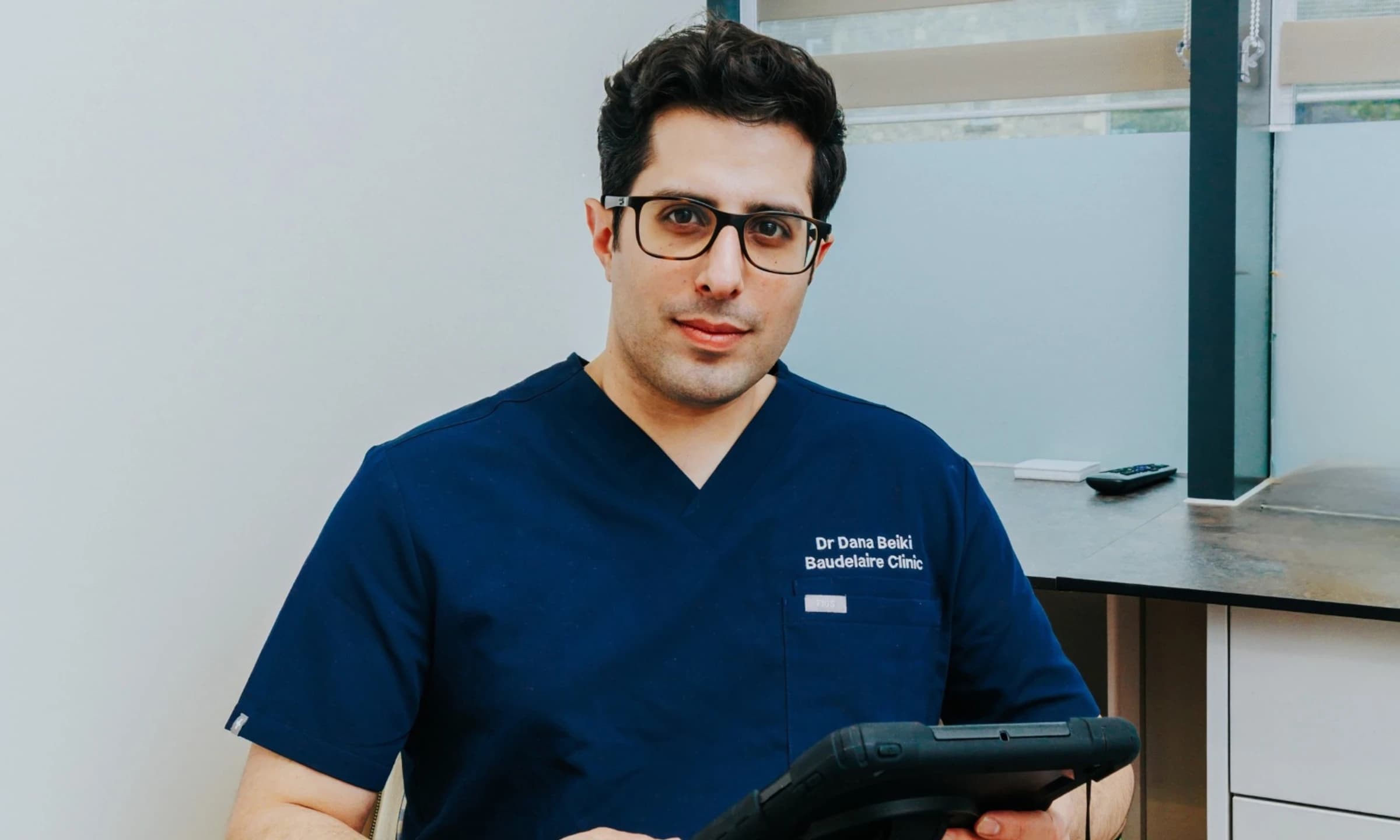
I am a pharmacist by training and a scientist by doctorate, and I was born and raised in Nice, on the south coast of France, to a Persian family. I grew up more or less expecting to become a pharmacist and to make my own creams one day. Those things explain this clinic better than any treatment list, so let me take them in order.
The pharmacist on the corner
Start with where I grew up. In France, when something is wrong with your skin, you do not begin with a surgeon or a spa. You go to the pharmacy and you ask the pharmacist. The green cross on every French street is not a chemist in the British sense of shampoo and paracetamol; it is the first place people take a question about their body, and the person behind the counter is trained to answer it. The skincare the rest of the world now queues for, those French names on every list, grew up on those pharmacy shelves, chosen and explained by people who understood what the ingredients did, and who would just as readily talk you out of the one you did not need.
So the idea of skin I grew up inside was this: something you reason about, chemically and patiently, with someone who has actually studied it. I was expected to become one of those people, a pharmacist with a line of creams of his own, and in a roundabout way I did. I trained as a pharmacist first, then took a doctorate in photobiology, the science of what light does to skin, which for someone raised in the Riviera sun is perhaps not a coincidence. By the time I trained in aesthetic medicine, the habit was fixed. I read a treatment the way a pharmacist reads a molecule: what does it really do, to whom, and where is the evidence. It is a quieter, more sceptical way into this work than most take, and I think the results are better for it.
A poet who spent his life on one question
I first met Charles Baudelaire, the nineteenth-century French poet the clinic is named for, at school in Nice, in the French and philosophy classes I mostly could not wait to leave. We were made to read Les Fleurs du mal, and I was set an essay on a single poem, L’Albatros, about the great seabird that is magnificent in the air and faintly absurd the moment the sailors drag it down onto the deck. I disliked almost everything about those lessons. I did not dislike Baudelaire. Something in him held, and stayed with me long after the exams were forgotten.
What stayed was the question he spent his life on: what beauty actually is. He reached a conclusion I have never been able to improve on. Beauty, he said, is always two things at once: one part eternal and shared, the quality every beautiful face has in common, and one part particular and passing, your own features, your age, the life written into your expression. Both halves matter. Erase the particular and you are left with a mannequin.
Most of aesthetic medicine treats only the first half. It keeps a single template in mind and moves everyone towards it. I wanted a clinic that worked the other way around, that treated the particular as the point rather than the fault. Naming it after Baudelaire was a way of holding myself to that. I wrote more about his idea, and how it shapes the actual treatment, in the piece on Le Cabinet.
Why no one can tell you what to get
Which brings me to the strangest thing about medical aesthetics, and the reason that panic at the booking page is so common. Aesthetics is sold as a menu of products: a named injectable, a named machine, a brand on a price list. The offering is a list of things to buy. And a list of things to buy has no way of answering the one honest question a patient actually has, which is not “how much is that treatment” but “what, if anything, do I need”.
It cannot answer it, because answering honestly often means selling you less. It means saying that the thing you read about is aimed at a problem you do not have, or that the right move this year is patience, or good skincare, or nothing at all. A business built on a product menu is not designed to say those things, so it does not, and you leave having chosen from a list you were never equipped to read.
The offering was never meant to be a product. It is an understanding of your face, and an honest account of what would actually help.
The problem the name answersWhat the name is a promise to do
So the offering at my clinic in Bath is not a product. It is an understanding. You come in, I read the whole face, I tell you plainly what is happening and what would genuinely help, and if something would help we plan it at the pace your skin actually moves. If nothing would, I will say that too, which a pharmacist is quite comfortable doing. The treatments themselves are written up in the same spirit, each on its own page: what it is, what it does and does not do, and the price. Profhilo and polynucleotides, two of the names the algorithms repeat, are fair examples. The French rigour about what actually works, and the poet’s respect for what makes your face yours, are meant to be one thing here, not two.
None of it was ever a business plan. A Persian boy raised in Nice, told he would grow up to be a pharmacist and make his own creams; who hated his French lessons but kept one poet from them; who then went and studied what the sun does to skin, having spent his childhood under it. Put like that, the clinic looks less like a decision I made than the place all of it had quietly been heading.
So the name on the door is a promise, and I have to keep it: that the honest answer to “what should I get” begins with understanding your face, not selling to it. But under the promise is something simpler that took me a while to say out loud. I did not really choose this work. I recognised it, and that is the whole of what I am offering.